
Extending
Beli
Restaurant discovery, for everyone at the table
Because your diet is not an edge case!
What Beli Hasn't Solved Yet
People with dietary restrictions love eating out too — the tools just haven't caught up.
People with cultural, religious, or medical dietary restrictions still want to enjoy eating out, but finding the right place often means doing extra work with incomplete, inconvenient, or unreliable information.
Yet the burden goes deeper than logistics. Restaurant discovery is fundamentally social, shaped by group outings and peer recommendations, and being the person with restrictions means contending with real anxiety and quiet exclusion before the meal even begins.
Role
Interaction Design
User Research
Usability Testing
Team of 4
What prompted us to reimagine Beli?
Eating out is one of the ways people build relationships, celebrate, work, date, and spend time with friends, but for people with dietary restrictions, that same social ritual can become stressful and isolating.

19%
increase in reported loneliness
Food restrictions limit the ability to bond with others through shared meals, making eating out a source of isolation, not connection.
Journal of Personality and Social Psychology
Food restrictions are not only medical; they can also be cultural, religious, ethical, and deeply personal, making this more than a menu-filtering problem. It is a social inclusion problem.
Beli is a growing social food app built around the idea that the best restaurant recommendations come from people you trust. Yet despite that promise, it leaves users with dietary needs to manually scan menus rather than benefit from those same community-driven recommendations. The people who need trusted recommendations the most are the ones least served by them.
Our team believes that people with dietary restrictions shouldn't feel like exceptions or need a separate app from the one their friends are using. The goal is to extend Beli so that dietary needs are centered in the experience, not treated as edge cases. This problem space is also personal to us: Three out of four team members are vegetarian due to cultural backgrounds, and all have close relationships with people managing allergies, intolerances, or chronic dietary needs
Business Insights
52%
of U.S. diners with exclusion diets struggle to find compliant meals when eating out
22M
Americans live with food allergies — layered with vegetarian, vegan, gluten-free, religious and chronic-health diets, the audience becomes far larger than a traditional "allergy filter" use case
$1.55T
projected U.S. restaurant sales in 2026, and 74% of diners now decide where to eat from social media.
RESTAURANT DIVE
JAMA NETWORK / AAFA
OYESTERLINK
Why this matters?
When someone cannot confidently tell whether a restaurant fits their needs, they may skip the restaurant, avoid the group plan, or disengage from the platform entirely. That creates lost trust for users, lost engagement for discovery platforms, and lost revenue opportunities for restaurants.
User Research
To better understand this problem space, we conducted 3 semi-structured interviews (30–45 min each) with people managing ongoing dietary restrictions, spanning food allergies, vegetarian and vegan diets, halal and kosher requirements, and gluten intolerance. We chose semi-structured interviews to give participants space to share personal, nuanced experiences while allowing us to probe deeper into moments of uncertainty or stress. Sessions were held in familiar environments to encourage openness around what is often an anxiety-laden topic.
We wanted to understand three things:
- How do people currently find restaurants that meet their restrictions?
- How do they feel throughout that process?
- What builds enough trust for them to actually commit to a choice?
That meant looking at:


which tools and people they rely on
where the experience, social and practical, breaks down
what workarounds they've developed
While three participants is a small sample, the consistency of patterns across very different restriction types gave us confidence in the themes that emerged.
Our Participants

Maya
Medical Restriction
Gluten intolerant
Dairy intolerant
Walnut allergy
Work-arounds
Cross-references Google, TikTok, Instagram, Reddit, and Yelp before committing to a single restaurant.
"It's a whole chore."
"I don't say anything because I'm one person in the friend group and I don't want to change everyone's plans."
Work-arounds
Eats before group dinners rather than risk navigating menus under social pressure.
Sahana
Medical Restriction
Severe nut allergy
Cultural Restriction
Vegetarian


Aya
Cultural Restriction
Halal
Work-arounds
Defaults to eating vegetarian at most restaurants rather than attempting to verify Halal status.
"I just eat vegetarian, but I don't mind it."
Key insights that shaped our design
1. Not all recommendations carry the same weight
Word of mouth is already the most trusted form of restaurant discovery but for people with dietary restrictions, that trust becomes even more specific. A recommendation only feels reliable when it comes from someone who understands the same stakes.
"If someone else is scared for their well-being the same way you are — you're going to trust them." This directed us toward restriction-aware social filtering within Beli's existing recommendation layer, so users can surface reviews from people who share their exact needs.
2. Critical safety information can't be found on a menu
Knowing a dish is gluten-free means nothing if the kitchen doesn't handle cross-contamination seriously. Users with severe allergies depend heavily on staff knowledge and restaurant practices, information that no menu, website, or general review reliably surfaces. This directed us toward a way for users to signal and share restriction-specific experiences beyond just a star rating, so that safety-critical context travels with the recommendation.
3. Finding a safe restaurant is a fragmented multi-platform ordeal
Users were cross-referencing Google, TikTok, Reddit, Yelp, and restaurant websites before committing to one meal. "I wish I didn't have to go to a separate app to verify if it was Halal or not." The opportunity for Beli is consolidating that trust into one place.
Preview
Eaters Like You
Eaters Like You opens Beli's social layer to a broader community of diners who share the same restrictions.
Friend groups rarely include someone with the exact same dietary need, so this feature lets users feed off recommendations from a wider, more relevant community.
A better Onboarding
Users with dietary restrictions arrive already cautious. They need to feel heard by the app before they can trust it.
User Profiles
Knowing what someone ate isn't enough. You need to know who they are to know how much weight to give their review. We updated profiles to make dietary restrictions clearly visible, so users can instantly gauge how relevant someone's recommendation is to their own situation.
Eaters Like You Evolution
Perspective 1
Passive, social discovery
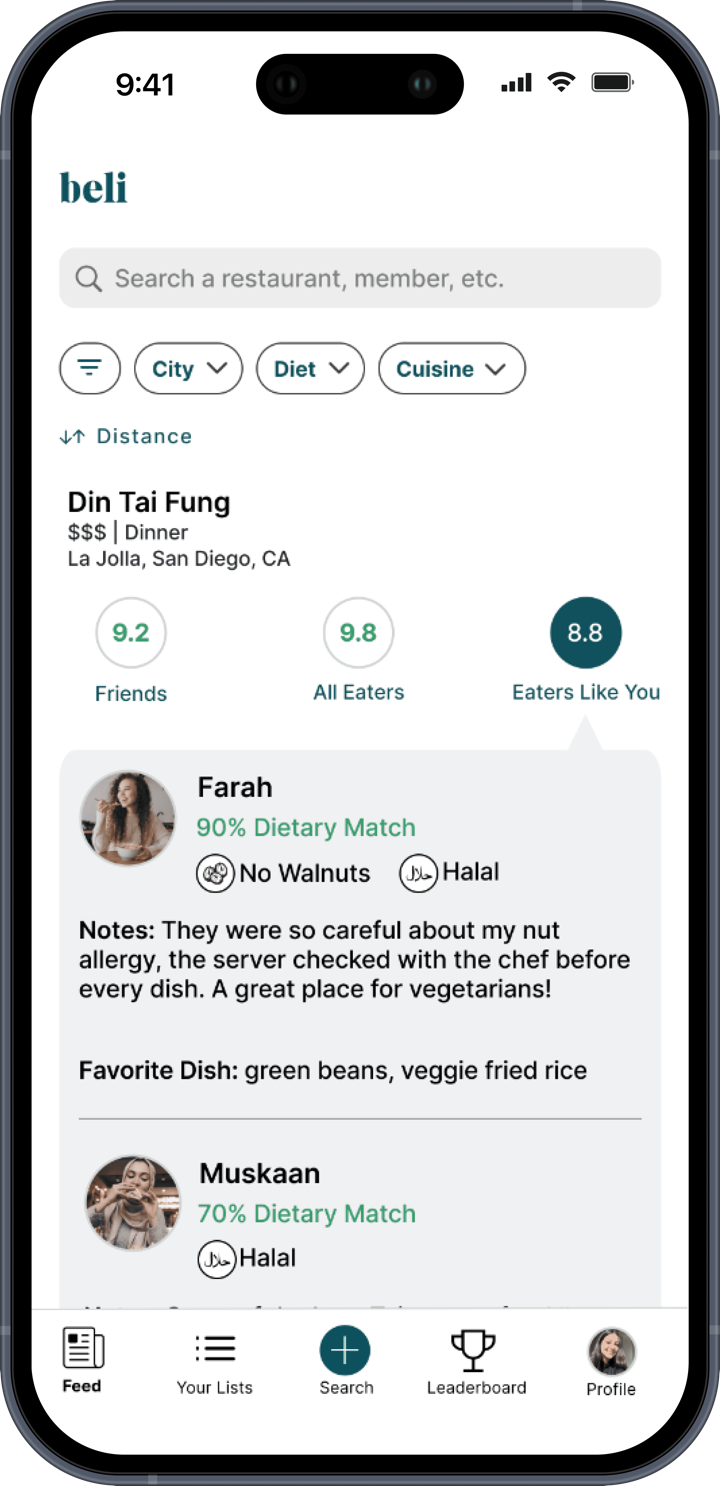
Designed for the browsing mindset when you're not looking for somewhere to eat right now, but building trust in people whose recommendations you can rely on later. Users follow others with the same restrictions and organically discover places through their saves and ratings.
"It's like a fun activity with friends because now, for example, I said another friend of mine has said she wants to go here. I can literally be like, oh, this is on your Beli. I literally eat out with her once a week. So now we can just find places we have in common and go there."
Perspective 2 - THE CHOSEN ONE
Active, goal directed search
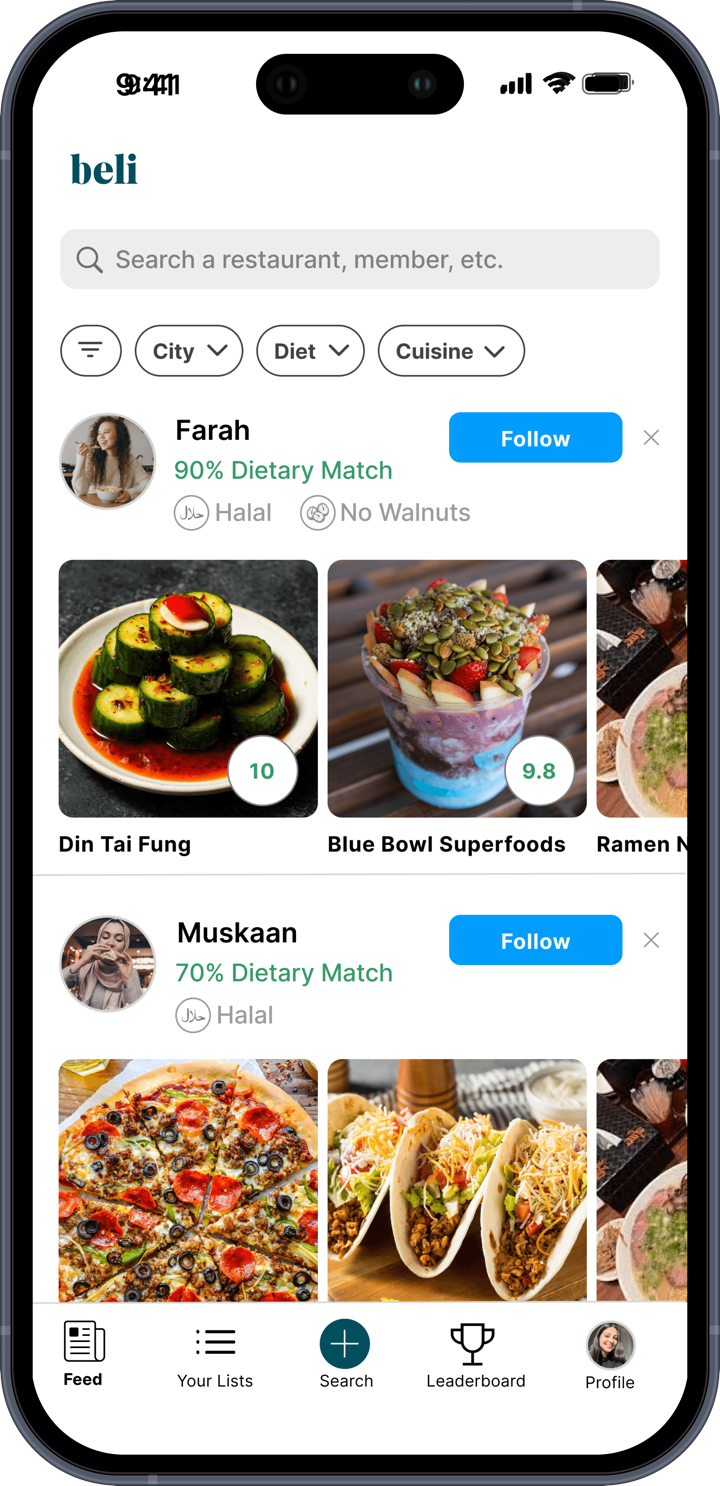
Designed for when you need a restaurant tonight and can't afford to get it wrong. The challenge isn't just finding somewhere safe; it's finding somewhere safe your friends will also want to go. This approach builds restriction-matched reviews right into the flow—letting you vet a place for yourself and the group at the same time, no extra digging required.
"If my friends want to go somewhere, I have to go in and check the menu myself to eat there. And if it's not something, if it's not a place that I can find food, then I just feel bad."
Participants preferred Perspective 2
What our user tests revealed:
1. Restaurant-first, not people-first
P2 led with restaurants, not profiles — matching what users actually open the app to do that is find somewhere to eat, not follow strangers.
2. Built-in trust signals
Surfacing the reviewer's dietary restrictions and match score let users judge relevance and safety at a glance, without digging through profiles.
3. Worked for quick and thorough users alike
Fast scanners could get a quick answer while more cautious users could scroll reviews for cross-contamination details.
How could we make P2 better?
Our users relied on two main things when deciding:
- What dietary restrictions does the reviewer have?
- Does the review help determine whether the restaurant handles cross-contamination safely?
"We need to make this more noticeable"
"They should only need to look at info that will help them"
Before
After
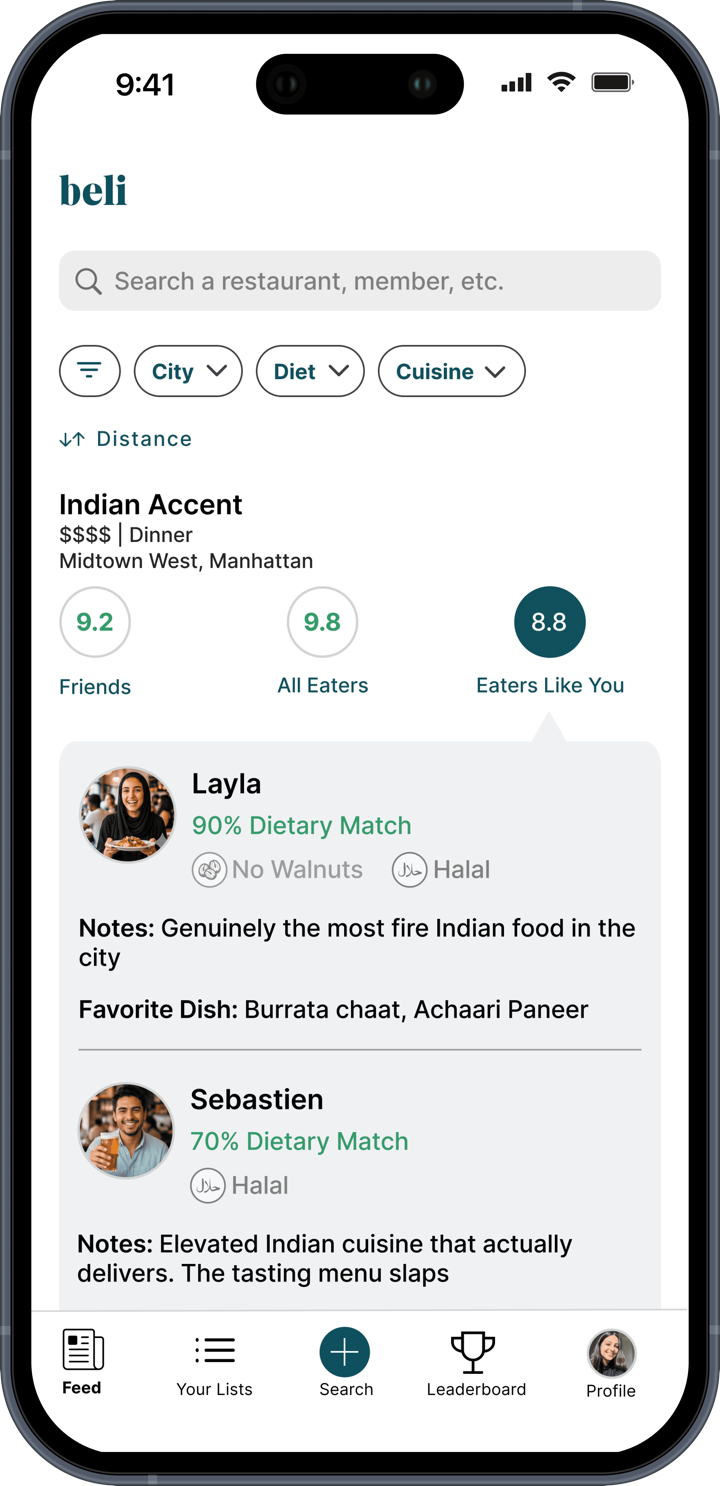
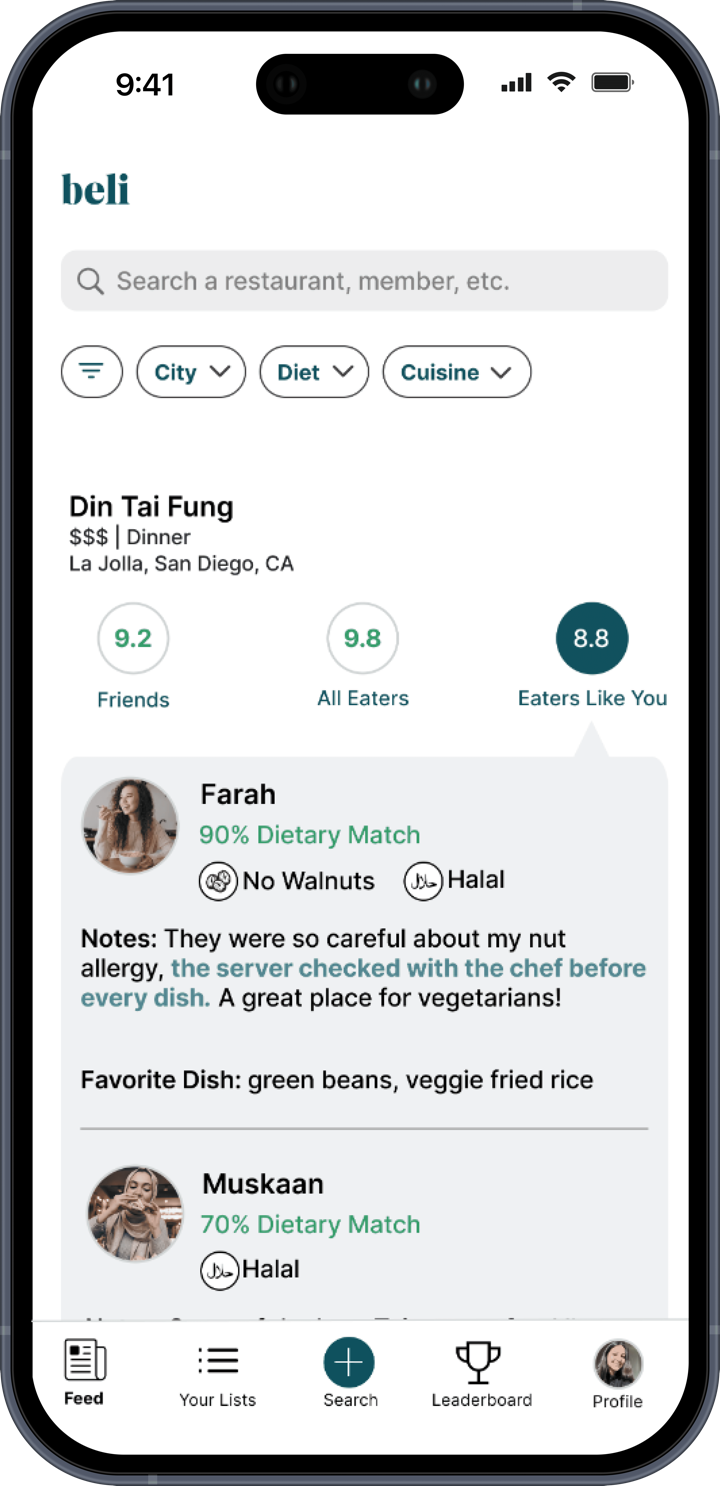
Made the dietary labels more noticeable
Bolded the keywords of reviews so that users grasp understand the take aways faster
Onboarding Evolution
Perspective 1 - THE CHOSEN ONE
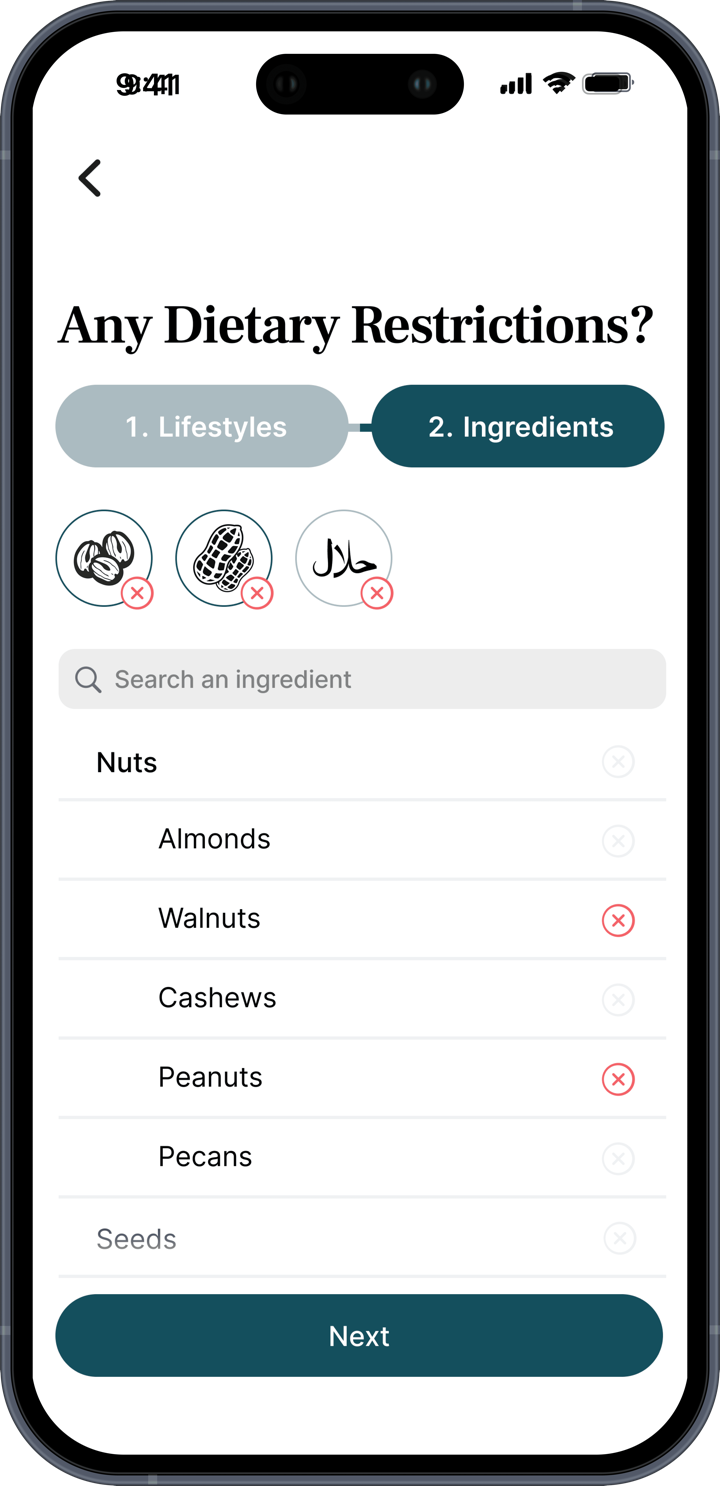
Checkbox list with real-time summary
This addressed our core design question: "How do I know the app understood me?" For users like Sahana, who felt anxious repeating herself to waiters and being "so perceived" at the table, seeing her restrictions reflected back in real time offered reassurance existing apps never provided.
Perspective 2
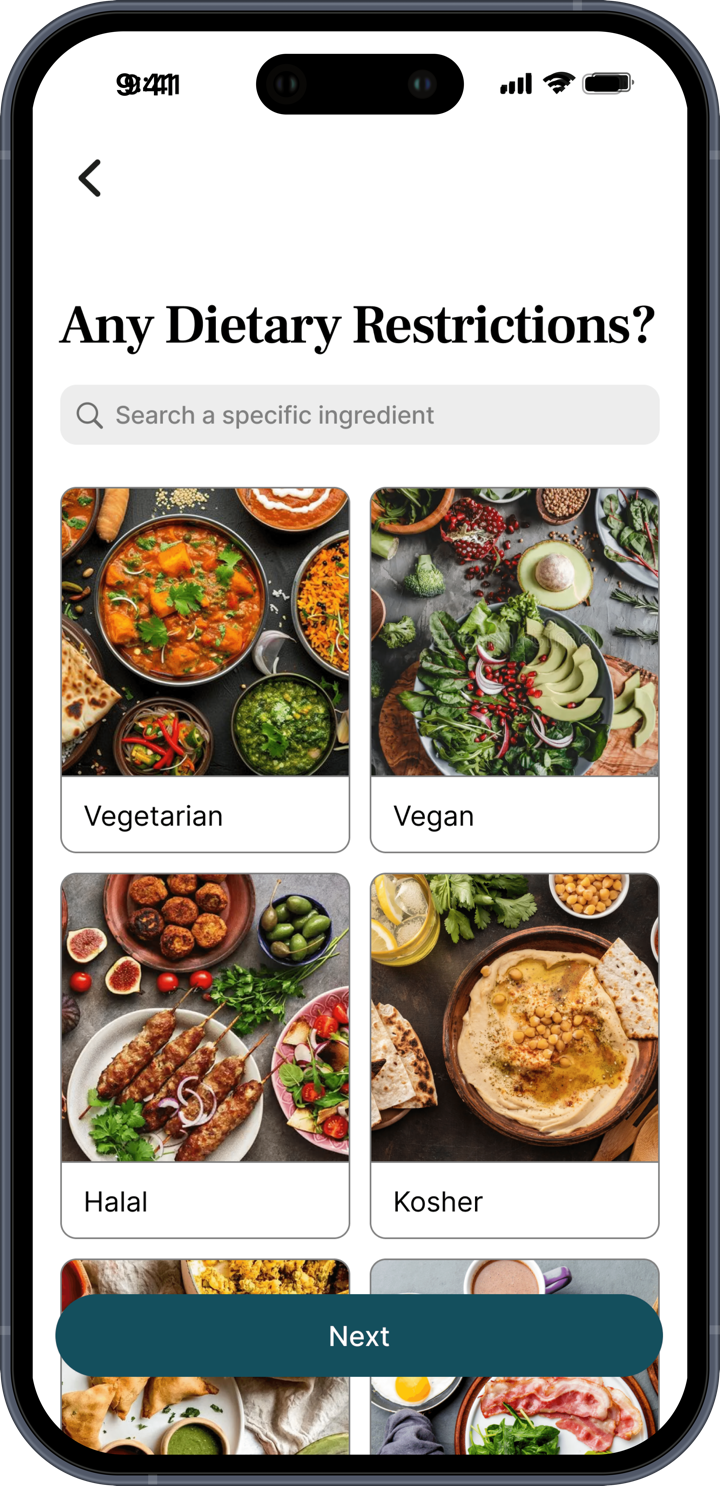
Visual lifestyle cards with end summary
Users select a lifestyle card and then refine it by deselecting ingredients that don't apply to them. As Maya noted, she filters for gluten first because "it does more of the heavy work" before thinking about dairy separately. Version 2 mirrors that layered thinking, letting users start broad and get specific rather than confronting every option at once.
Participants preferred Perspective 1
1. Everything visible in one place
Having all selections on the same page let users scan and confirm quickly, without navigating between screens.
2. Real-time confirmation built trust
Icons updating live as users selected restrictions reassured them the app understood their needs, directly easing the anxiety of feeling unheard.
Before
After
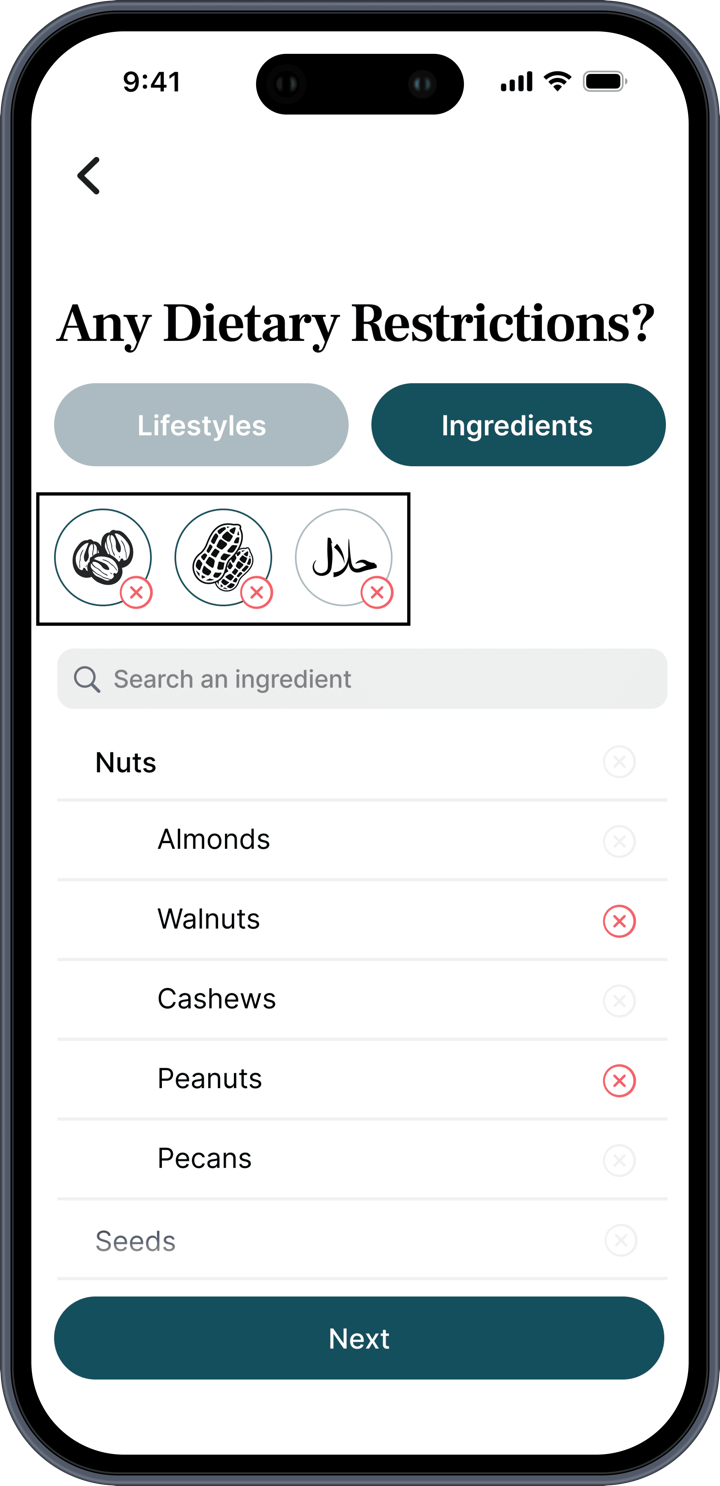
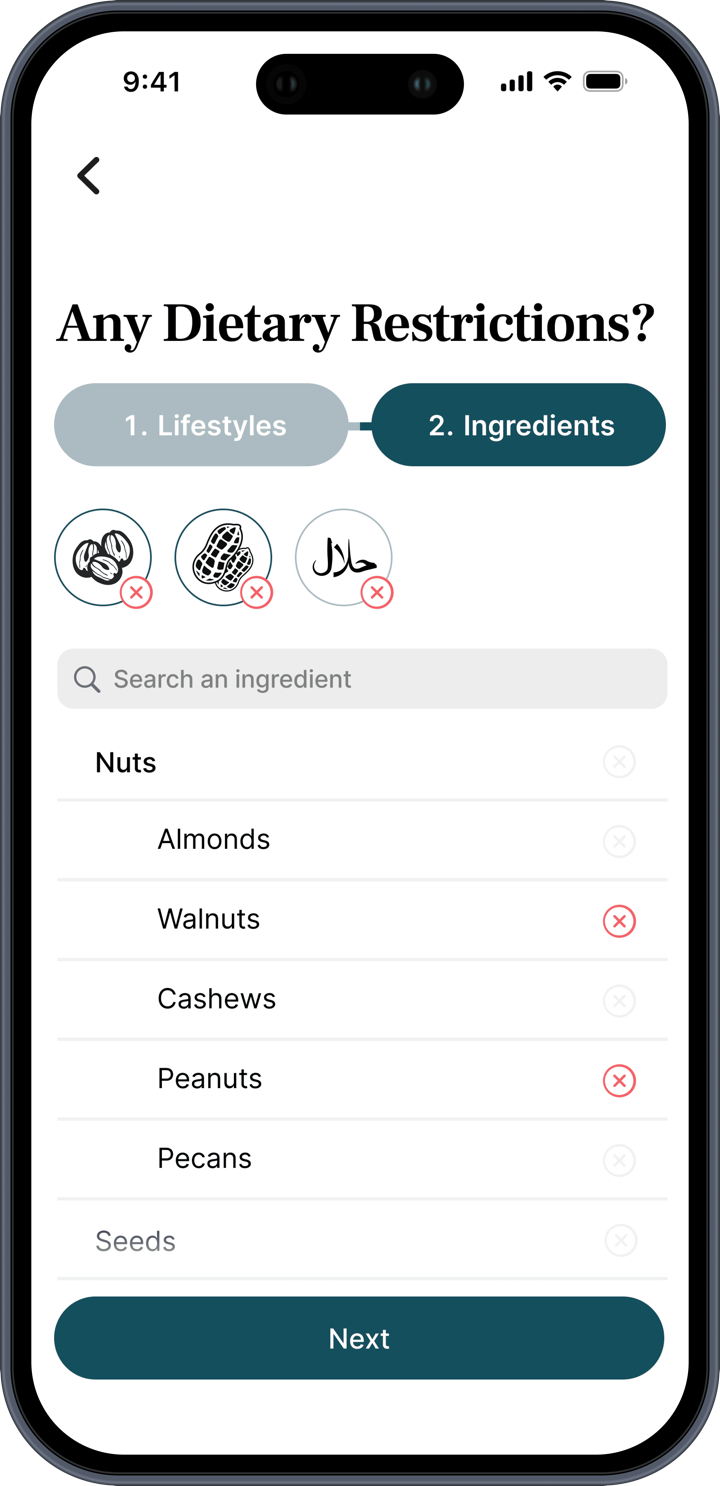
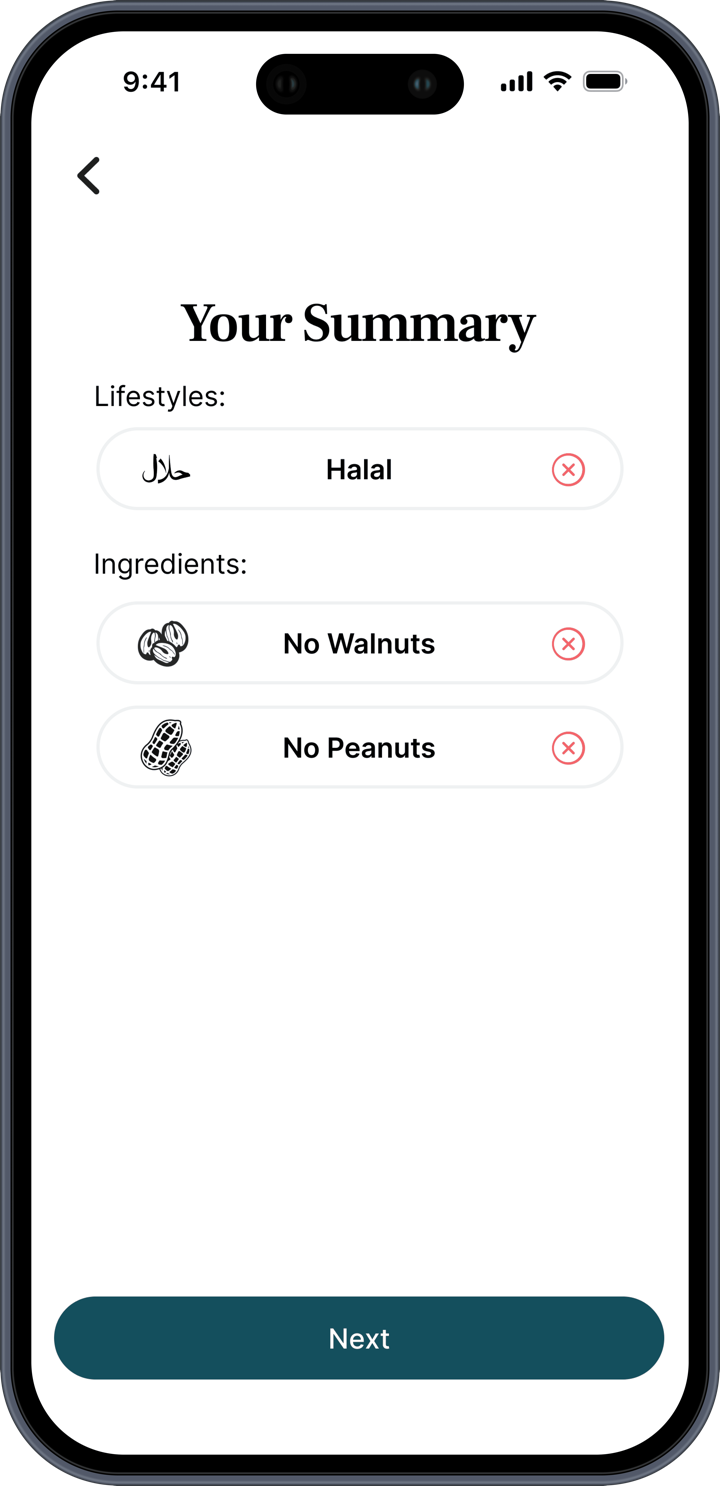
Added numbers to signify the steps of the onboarding flow
Directed the "Next" button to take users from the Lifestyles to the Ingredients tab
Added a confirmation screen for more clarity and reassurance
A special thanks to Professor Philip Guo for crafting COGS 127 Data-Driven UX/Product Design. This course has helped me overcome a long-standing anxiety of creating a case study and has helped me develop my skills in presenting my work :)
What Beli Hasn't Solved Yet
People with dietary restrictions love eating out too — the tools just haven't caught up.
Role
Interaction Design · User Research · Usability Testing · Team of 4
People with cultural, religious, or medical dietary restrictions still want to enjoy eating out, but finding the right place often means doing extra work with incomplete, inconvenient, or unreliable information.
Yet the burden goes deeper than logistics. Restaurant discovery is fundamentally social, shaped by group outings and peer recommendations, and being the person with restrictions means contending with real anxiety and quiet exclusion before the meal even begins.
What prompted us to reimagine Beli?
Eating out is one of the ways people build relationships, celebrate, work, date, and spend time with friends, but for people with dietary restrictions, that same social ritual can become stressful and isolating.
19%
increase in reported loneliness
Food restrictions limit the ability to bond with others through shared meals, making eating out a source of isolation, not connection.
Journal of Personality and Social Psychology
Food restrictions are not only medical; they can also be cultural, religious, ethical, and deeply personal, making this more than a menu-filtering problem. It is a social inclusion problem.
Beli is a growing social food app built around the idea that the best restaurant recommendations come from people you trust. Yet despite that promise, it leaves users with dietary needs to manually scan menus rather than benefit from those same community-driven recommendations. The people who need trusted recommendations the most are the ones least served by them.
Our team believes that people with dietary restrictions shouldn't feel like exceptions or need a separate app from the one their friends are using. The goal is to extend Beli so that dietary needs are centered in the experience, not treated as edge cases. This problem space is also personal to us: Three out of four team members are vegetarian due to cultural backgrounds, and all have close relationships with people managing allergies, intolerances, or chronic dietary needs
Business Insights
52%
22M
$1.55T
of U.S. diners with exclusion diets struggle to find compliant meals when eating out
Americans live with food allergies — layered with vegetarian, vegan, gluten-free, religious and chronic-health diets, the audience becomes far larger than a traditional "allergy filter" use case
projected U.S. restaurant sales in 2026, and 74% of diners now decide where to eat from social media.
RESTAURANT DIVE
JAMA NETWORK / AAFA
OYESTERLINK
Why this matters?
When someone cannot confidently tell whether a restaurant fits their needs, they may skip the restaurant, avoid the group plan, or disengage from the platform entirely. That creates lost trust for users, lost engagement for discovery platforms, and lost revenue opportunities for restaurants.
User Research
To better understand this problem space, we conducted 3 semi-structured interviews (30–45 min each) with people managing ongoing dietary restrictions, spanning food allergies, vegetarian and vegan diets, halal and kosher requirements, and gluten intolerance. We chose semi-structured interviews to give participants space to share personal, nuanced experiences while allowing us to probe deeper into moments of uncertainty or stress. Sessions were held in familiar environments to encourage openness around what is often an anxiety-laden topic.
We wanted to understand three things:
- How do people currently find restaurants that meet their restrictions?
- How do they feel throughout that process?
- What builds enough trust for them to actually commit to a choice?
That meant looking at:
which tools and people they rely on
where the experience, social and practical, breaks down
what workarounds they've developed
While three participants is a small sample, the consistency of patterns across very different restriction types gave us confidence in the themes that emerged.
Our Participants
Maya
Medical Restriction
Gluten intolerant
Dairy intolerant
Walnut allergy
Work-arounds
Cross-references Google, TikTok, Instagram, Reddit, and Yelp before committing to a single restaurant.
"It's a whole chore."
Sahana
Medical Restriction
Severe nut allergy
Cultural Restriction
Vegetarian
Work-arounds
Eats before group dinners rather than risk navigating menus under social pressure.
"I don't say anything because I'm one person in the friend group and I don't want to change everyone's plans."
Aya
Cultural Restriction
Halal
Work-arounds
Defaults to eating vegetarian at most restaurants rather than attempting to verify Halal status.
"I just eat vegetarian, but I don't mind it."
Key insights that shaped our design
1. Not all recommendations carry the same weight
Word of mouth is already the most trusted form of restaurant discovery but for people with dietary restrictions, that trust becomes even more specific. A recommendation only feels reliable when it comes from someone who understands the same stakes.
"If someone else is scared for their well-being the same way you are — you're going to trust them." This directed us toward restriction-aware social filtering within Beli's existing recommendation layer, so users can surface reviews from people who share their exact needs.
2. Critical safety information can't be found on a menu
Knowing a dish is gluten-free means nothing if the kitchen doesn't handle cross-contamination seriously. Users with severe allergies depend heavily on staff knowledge and restaurant practices, information that no menu, website, or general review reliably surfaces. This directed us toward a way for users to signal and share restriction-specific experiences beyond just a star rating, so that safety-critical context travels with the recommendation.
3. Finding a safe restaurant is a fragmented multi-platform ordeal
Users were cross-referencing Google, TikTok, Reddit, Yelp, and restaurant websites before committing to one meal. "I wish I didn't have to go to a separate app to verify if it was Halal or not." The opportunity for Beli is consolidating that trust into one place.
Preview
Eaters Like You
Eaters Like You opens Beli's social layer to a broader community of diners who share the same restrictions.
Friend groups rarely include someone with the exact same dietary need, so this feature lets users feed off recommendations from a wider, more relevant community.
A better Onboarding
Users with dietary restrictions arrive already cautious. They need to feel heard by the app before they can trust it.
User Profiles
Knowing what someone ate isn't enough. You need to know who they are to know how much weight to give their review. We updated profiles to make dietary restrictions clearly visible, so users can instantly gauge how relevant someone's recommendation is to their own situation.
Eaters Like You Evolution
Perspective 1
Passive, social discovery
Designed for the browsing mindset when you're not looking for somewhere to eat right now, but building trust in people whose recommendations you can rely on later. Users follow others with the same restrictions and organically discover places through their saves and ratings.
"It's like a fun activity with friends because now, for example, I said another friend of mine has said she wants to go here. I can literally be like, oh, this is on your Beli. I literally eat out with her once a week. So now we can just find places we have in common and go there."
Perspective 2 - THE CHOSEN ONE
Active, goal directed search
Designed for when you need a restaurant tonight and can't afford to get it wrong. The challenge isn't just finding somewhere safe; it's finding somewhere safe your friends will also want to go. This approach builds restriction-matched reviews right into the flow—letting you vet a place for yourself and the group at the same time, no extra digging required.
"If my friends want to go somewhere, I have to go in and check the menu myself to eat there. And if it's not something, if it's not a place that I can find food, then I just feel bad."
Participants preferred Perspective 2
What our user tests revealed:
1. Restaurant-first, not people-first
P2 led with restaurants, not profiles — matching what users actually open the app to do that is find somewhere to eat, not follow strangers.
2. Built-in trust signals
Surfacing the reviewer's dietary restrictions and match score let users judge relevance and safety at a glance, without digging through profiles.
3. Worked for quick and thorough users alike
Fast scanners could get a quick answer while more cautious users could scroll reviews for cross-contamination details.
How could we make P2 better?
Our users relied on two main things when deciding:
• What dietary restrictions does the reviewer have?
"We need to make this more noticeable"
• Does the review help determine whether the restaurant handles cross-contamination safely?
"They should only need to look at info that will help them"
Before
After
Made the dietary labels more noticeable
Bolded the keywords of reviews so that users grasp understand the take aways faster
Onboarding Evolution
Perspective 1 - THE CHOSEN ONE
Checkbox list with real-time summary
This addressed our core design question: "How do I know the app understood me?" For users like Sahana, who felt anxious repeating herself to waiters and being "so perceived" at the table, seeing her restrictions reflected back in real time offered reassurance existing apps never provided.
Perspective 2
Visual lifestyle cards with end summary
Users select a lifestyle card and then refine it by deselecting ingredients that don't apply to them. As Maya noted, she filters for gluten first because "it does more of the heavy work" before thinking about dairy separately. Version 2 mirrors that layered thinking, letting users start broad and get specific rather than confronting every option at once.
Participants preferred Perspective 1
1. Everything visible in one place
Having all selections on the same page let users scan and confirm quickly, without navigating between screens.
2. Real-time confirmation built trust
Icons updating live as users selected restrictions reassured them the app understood their needs, directly easing the anxiety of feeling unheard.
Before
After
Added numbers to signify the steps of the onboarding flow
Directed the "Next" button to take users from the Lifestyles to the Ingredients tab
Added a confirmation screen for more clarity and reassurance
A special thanks to Professor Philip Guo for crafting COGS 127 Data-Driven UX/Product Design. This course has helped me overcome a long-standing anxiety of creating a case study and has helped me develop my skills in presenting my work :)
Extending
Beli
Restaurant discovery, for everyone at the table
Because your diet is not an edge case!
What Beli Hasn't Solved Yet
Interaction Design
User Research
Usability Testing
Team of 4
Role
Yet the burden goes deeper than logistics. Restaurant discovery is fundamentally social, shaped by group outings and peer recommendations, and being the person with restrictions means contending with real anxiety and quiet exclusion before the meal even begins.
People with cultural, religious, or medical dietary restrictions still want to enjoy eating out, but finding the right place often means doing extra work with incomplete, inconvenient, or unreliable information.
People with dietary restrictions love eating out too — the tools just haven't caught up.
What prompted us to reimagine Beli?
19%
increase in reported loneliness
Food restrictions limit the ability to bond with others through shared meals, making eating out a source of isolation, not connection.
Journal of Personality and Social Psychology
Food restrictions are not only medical; they can also be cultural, religious, ethical, and deeply personal, making this more than a menu-filtering problem. It is a social inclusion problem.
Beli is a growing social food app built around the idea that the best restaurant recommendations come from people you trust. Yet despite that promise, it leaves users with dietary needs to manually scan menus rather than benefit from those same community-driven recommendations. The people who need trusted recommendations the most are the ones least served by them.
Our team believes that people with dietary restrictions shouldn't feel like exceptions or need a separate app from the one their friends are using. The goal is to extend Beli so that dietary needs are centered in the experience, not treated as edge cases. This problem space is also personal to us: Three out of four team members are vegetarian due to cultural backgrounds, and all have close relationships with people managing allergies, intolerances, or chronic dietary needs
Eating out is one of the ways people build relationships, celebrate, work, date, and spend time with friends, but for people with dietary restrictions, that same social ritual can become stressful and isolating.
Business Insights
52%
of U.S. diners with exclusion diets struggle to find compliant meals when eating out
RESTAURANT DIVE
22M
Americans live with food allergies — layered with vegetarian, vegan, gluten-free, religious and chronic-health diets, the audience becomes far larger than a traditional "allergy filter" use case
JAMA NETWORK / AAFA
$1.55T
projected U.S. restaurant sales in 2026, and 74% of diners now decide where to eat from social media.
OYESTERLINK
Why this matters?
When someone cannot confidently tell whether a restaurant fits their needs, they may skip the restaurant, avoid the group plan, or disengage from the platform entirely. That creates lost trust for users, lost engagement for discovery platforms, and lost revenue opportunities for restaurants.
User Research
To better understand this problem space, we conducted 3 semi-structured interviews (30–45 min each) with people managing ongoing dietary restrictions, spanning food allergies, vegetarian and vegan diets, halal and kosher requirements, and gluten intolerance. We chose semi-structured interviews to give participants space to share personal, nuanced experiences while allowing us to probe deeper into moments of uncertainty or stress. Sessions were held in familiar environments to encourage openness around what is often an anxiety-laden topic.
We wanted to understand three things:
- How do people currently find restaurants that meet their restrictions?
- How do they feel throughout that process?
- What builds enough trust for them to actually commit to a choice?
That meant looking at:
which tools and people they rely on
what workarounds they've developed
where the experience, social and practical, breaks down
While three participants is a small sample, the consistency of patterns across very different restriction types gave us confidence in the themes that emerged.
Our Participants
Maya
Medical Restriction
Gluten intolerant
Dairy intolerant
Walnut allergy
Work-arounds
Cross-references Google, TikTok, Instagram, Reddit, and Yelp before committing to a single restaurant.
"It's a whole chore."
Sahana
Medical Restriction
Severe nut allergy
Cultural Restriction
Vegetarian
Work-arounds
Eats before group dinners rather than risk navigating menus under social pressure.
"I don't say anything because I'm one person in the friend group and I don't want to change everyone's plans."
Aya
Cultural Restriction
Halal
Work-arounds
Defaults to eating vegetarian at most restaurants rather than attempting to verify Halal status.
"I just eat vegetarian, but I don't mind it."
Key insights that shaped our design
1. Not all recommendations carry the same weight
Word of mouth is already the most trusted form of restaurant discovery but for people with dietary restrictions, that trust becomes even more specific. A recommendation only feels reliable when it comes from someone who understands the same stakes.
"If someone else is scared for their well-being the same way you are — you're going to trust them." This directed us toward restriction-aware social filtering within Beli's existing recommendation layer, so users can surface reviews from people who share their exact needs.
2. Critical safety information can't be found on a menu
Knowing a dish is gluten-free means nothing if the kitchen doesn't handle cross-contamination seriously. Users with severe allergies depend heavily on staff knowledge and restaurant practices, information that no menu, website, or general review reliably surfaces. This directed us toward a way for users to signal and share restriction-specific experiences beyond just a star rating, so that safety-critical context travels with the recommendation.
3. Finding a safe restaurant is a fragmented multi-platform ordeal
Users were cross-referencing Google, TikTok, Reddit, Yelp, and restaurant websites before committing to one meal. "I wish I didn't have to go to a separate app to verify if it was Halal or not." The opportunity for Beli is consolidating that trust into one place.
Preview

Eaters Like You
Eaters Like You opens Beli's social layer to a broader community of diners who share the same restrictions.
Friend groups rarely include someone with the exact same dietary need, so this feature lets users feed off recommendations from a wider, more relevant community.
A better Onboarding
Users with dietary restrictions arrive already cautious. They need to feel heard by the app before they can trust it.
User Profiles
Knowing what someone ate isn't enough. You need to know who they are to know how much weight to give their review. We updated profiles to make dietary restrictions clearly visible, so users can instantly gauge how relevant someone's recommendation is to their own situation.
Eaters Like You Evolution
Perspective 1
Passive, social discovery
Designed for the browsing mindset when you're not looking for somewhere to eat right now, but building trust in people whose recommendations you can rely on later. Users follow others with the same restrictions and organically discover places through their saves and ratings.
"It's like a fun activity with friends because now, for example, I said another friend of mine has said she wants to go here. I can literally be like, oh, this is on your Beli. I literally eat out with her once a week. So now we can just find places we have in common and go there."
Perspective 2 - THE CHOSEN ONE
Active, goal directed search
Designed for when you need a restaurant tonight and can't afford to get it wrong. The challenge isn't just finding somewhere safe; it's finding somewhere safe your friends will also want to go. This approach builds restriction-matched reviews right into the flow—letting you vet a place for yourself and the group at the same time, no extra digging required.
"If my friends want to go somewhere, I have to go in and check the menu myself to eat there. And if it's not something, if it's not a place that I can find food, then I just feel bad."
Participants preferred Perspective 2
What our user tests revealed:
1. Restaurant-first, not people-first
P2 led with restaurants, not profiles — matching what users actually open the app to do that is find somewhere to eat, not follow strangers.
2. Built-in trust signals
Surfacing the reviewer's dietary restrictions and match score let users judge relevance and safety at a glance, without digging through profiles.
3. Worked for quick and thorough users alike
Fast scanners could get a quick answer while more cautious users could scroll reviews for cross-contamination details.
How could we make P2 better?
Our users relied on two main things when deciding:
- What dietary restrictions does the reviewer have?
- Does the review help determine whether the restaurant handles cross-contamination safely?
"We need to make this more noticeable"
"They should only need to look at info that will help them"
Before
Made the dietary labels more noticeable
After
Bolded the keywords of reviews so that users grasp understand the take aways faster
Onboarding Evolution
Perspective 1 - THE CHOSEN ONE
Checkbox list with real-time summary
This addressed our core design question: "How do I know the app understood me?" For users like Sahana, who felt anxious repeating herself to waiters and being "so perceived" at the table, seeing her restrictions reflected back in real time offered reassurance existing apps never provided.
Perspective 2
Visual lifestyle cards with end summary
Users select a lifestyle card and then refine it by deselecting ingredients that don't apply to them. As Maya noted, she filters for gluten first because "it does more of the heavy work" before thinking about dairy separately. Version 2 mirrors that layered thinking, letting users start broad and get specific rather than confronting every option at once.
Participants preferred Perspective 1
1. Everything visible in one place
Having all selections on the same page let users scan and confirm quickly, without navigating between screens.
2. Real-time confirmation built trust
Icons updating live as users selected restrictions reassured them the app understood their needs, directly easing the anxiety of feeling unheard.
Before
After
Added numbers to signify the steps of the onboarding flow
Directed the "Next" button to take users from the Lifestyles to the Ingredients tab
Added a confirmation screen for more clarity and reassurance
A special thanks to Professor Philip Guo for crafting COGS 127 Data-Driven UX/Product Design. This course has helped me overcome a long-standing anxiety of creating a case study and has helped me develop my skills in presenting my work :)