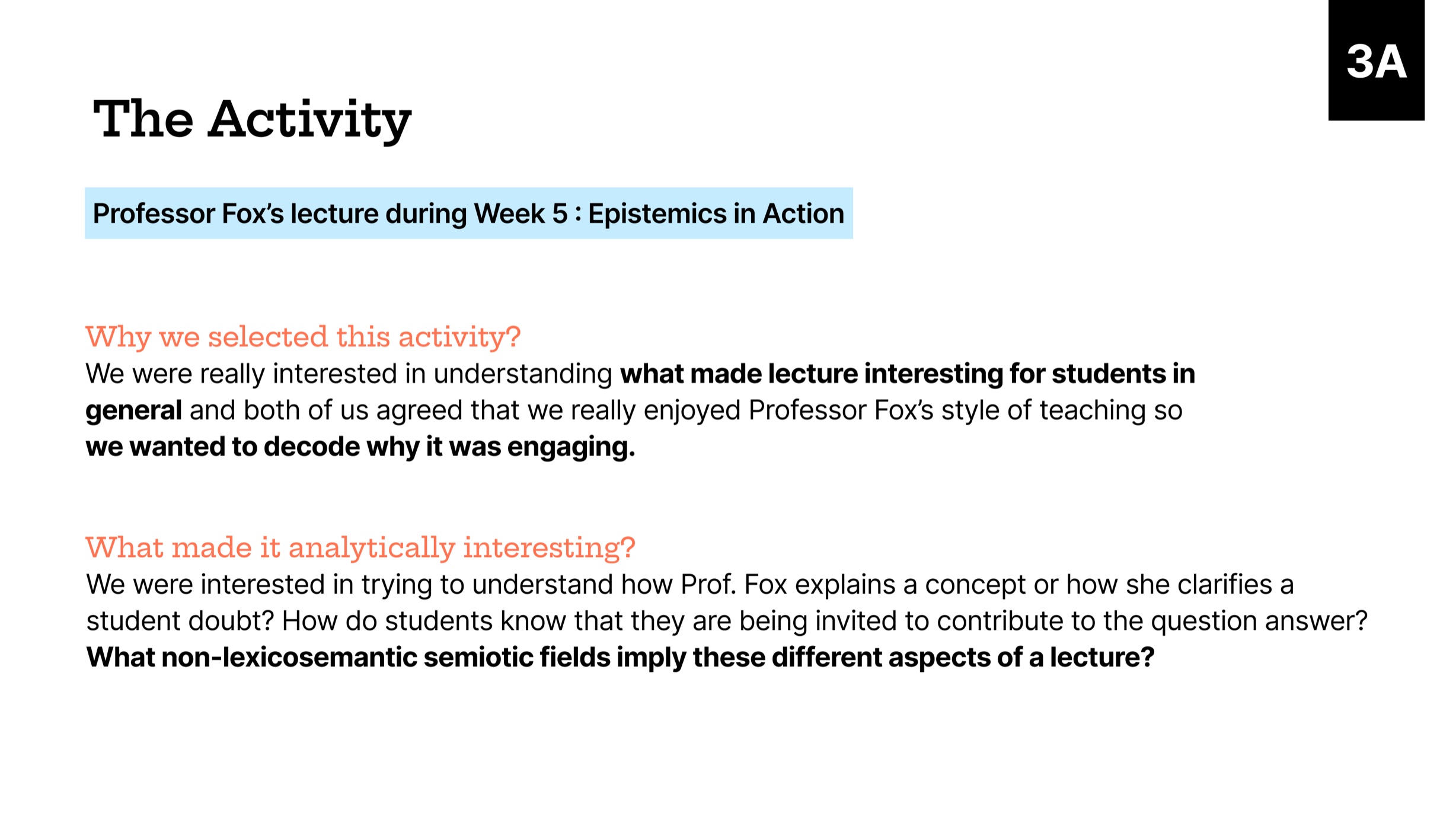

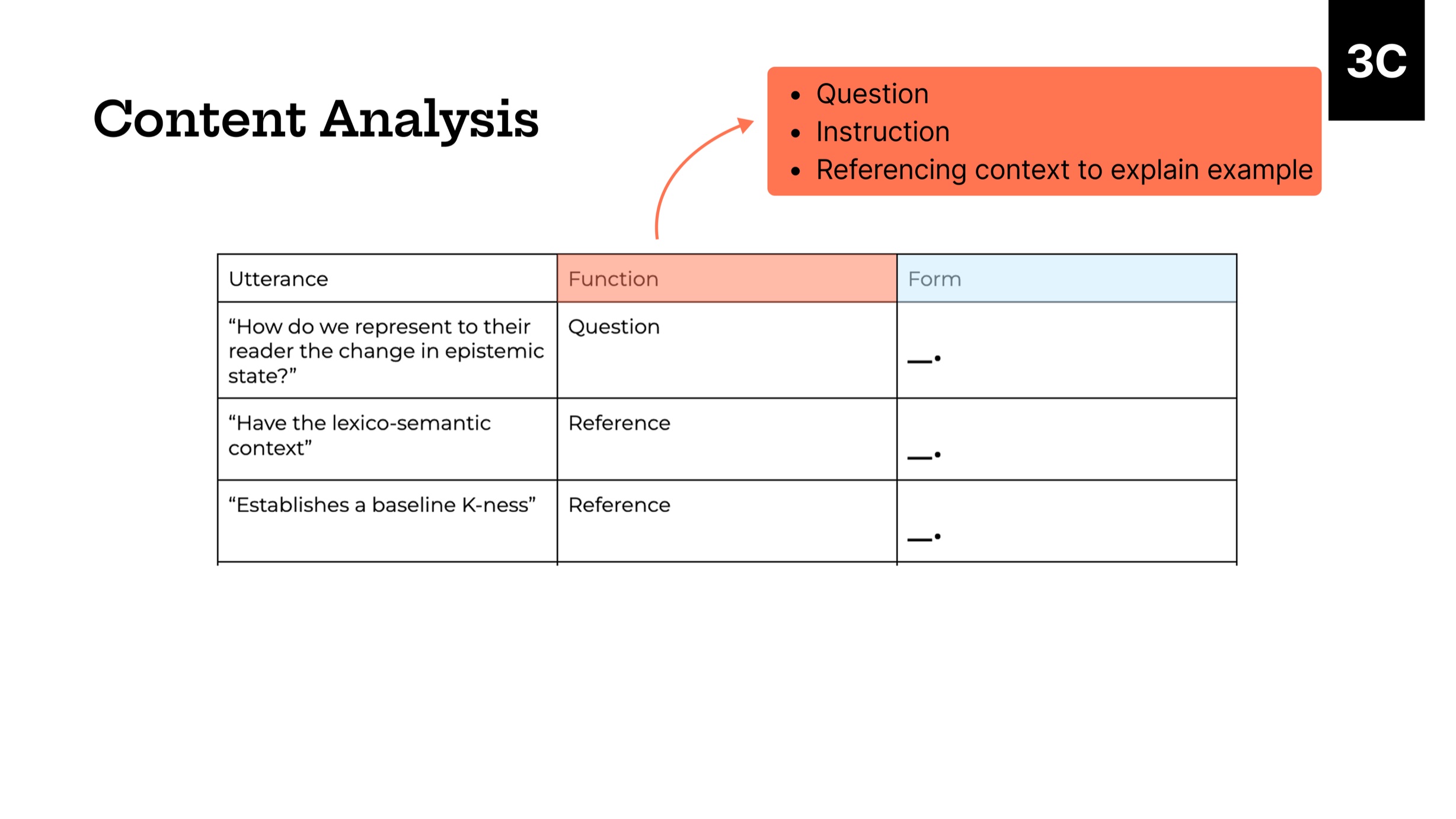
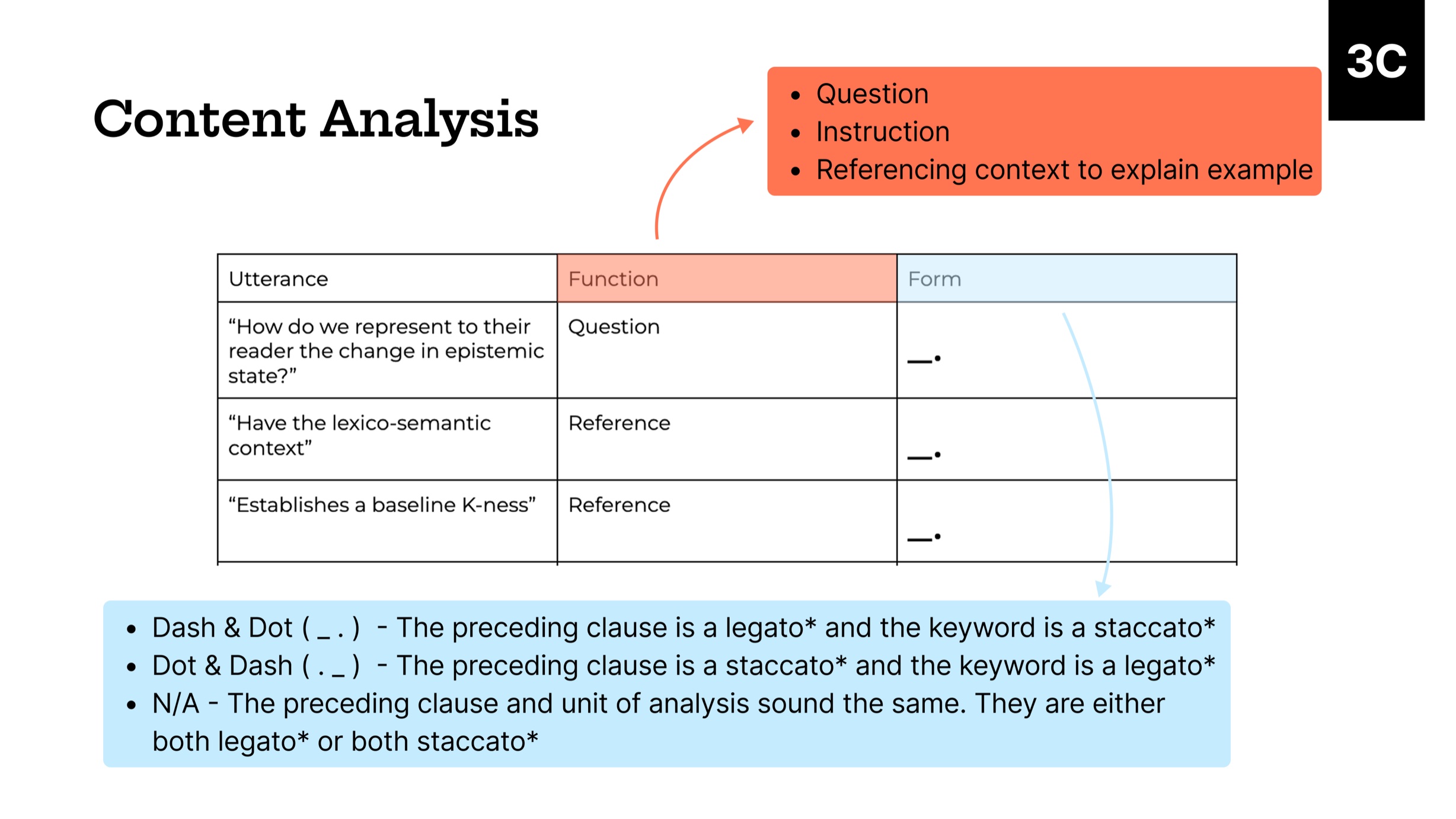
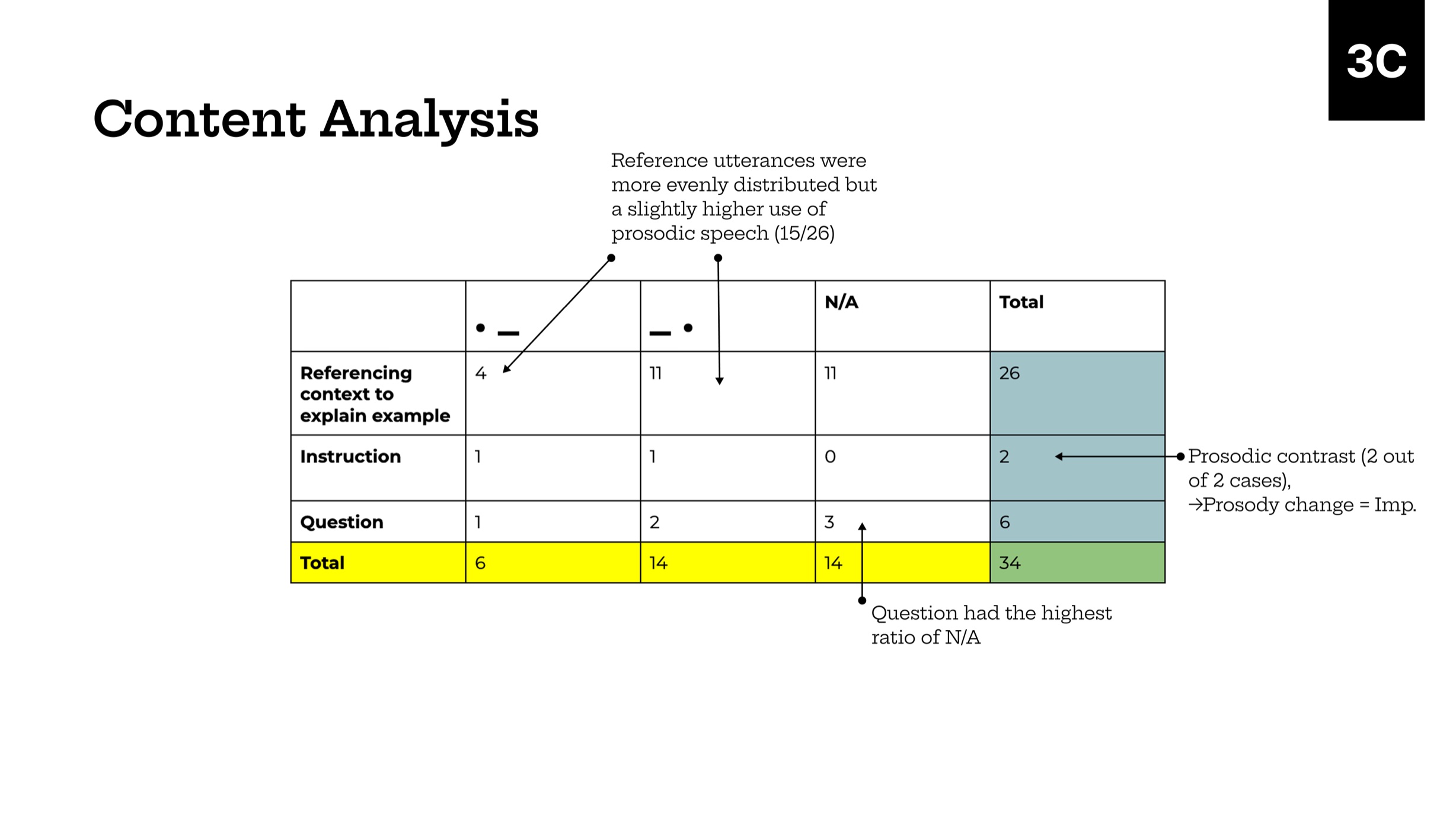
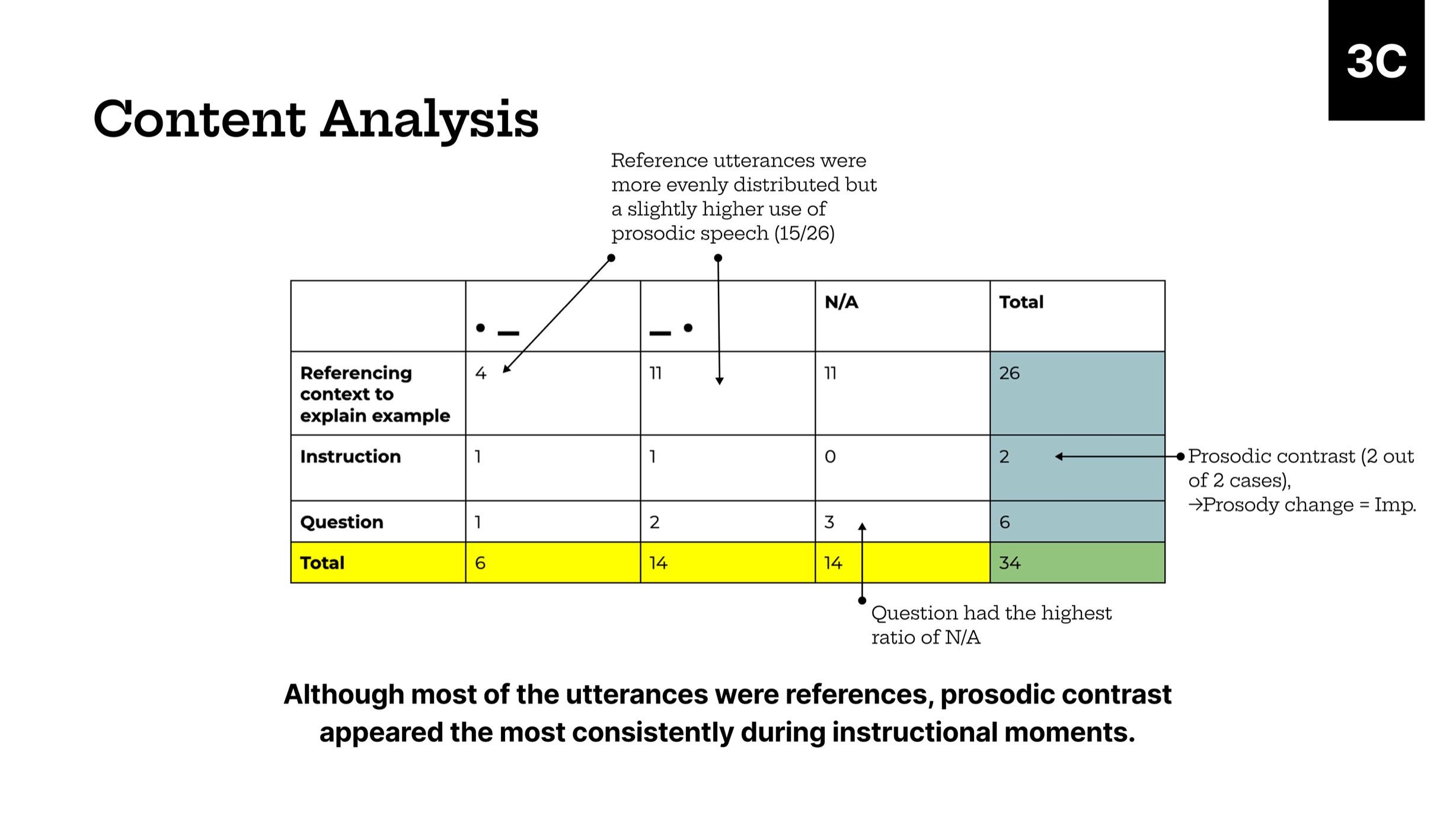
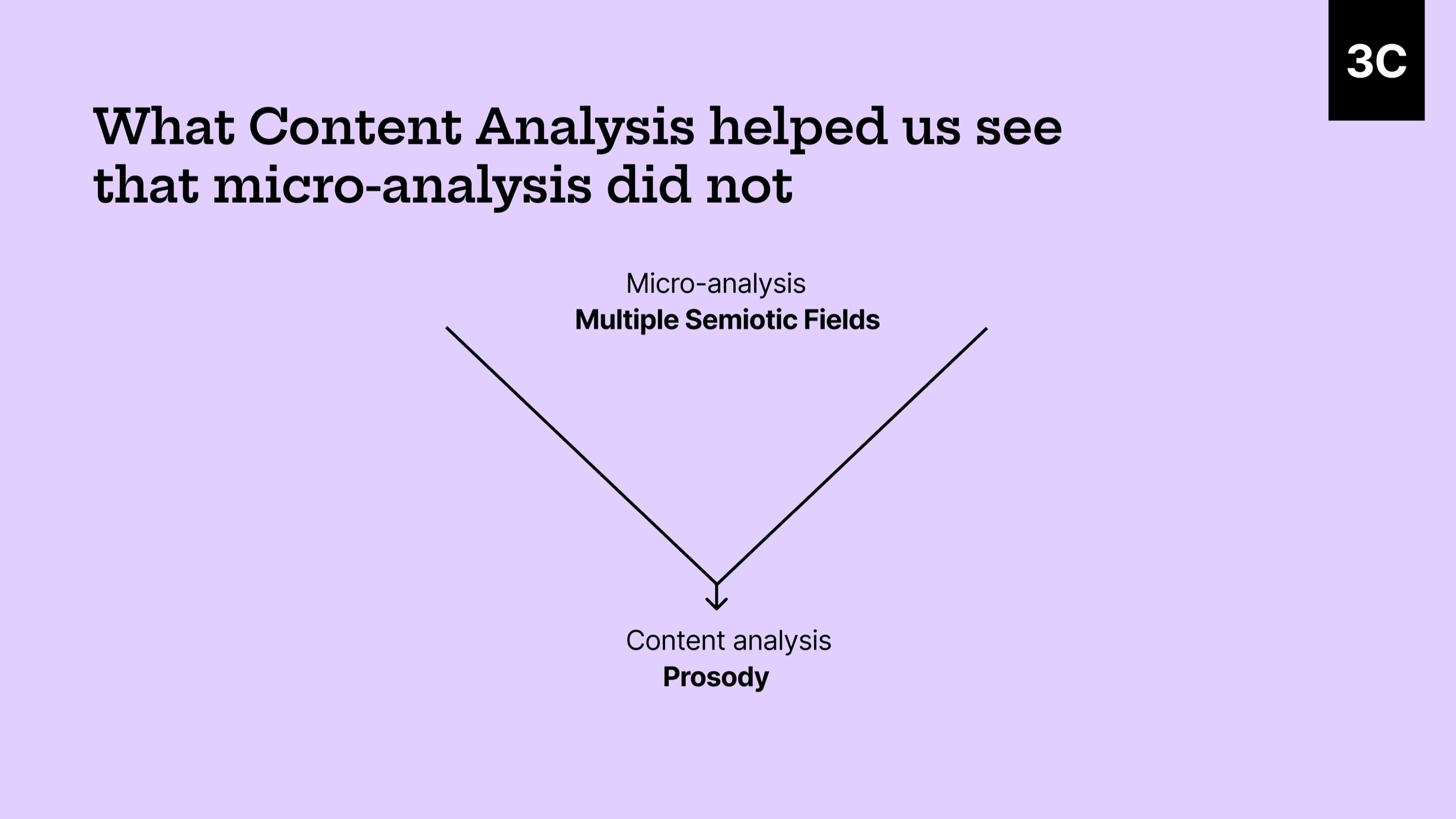
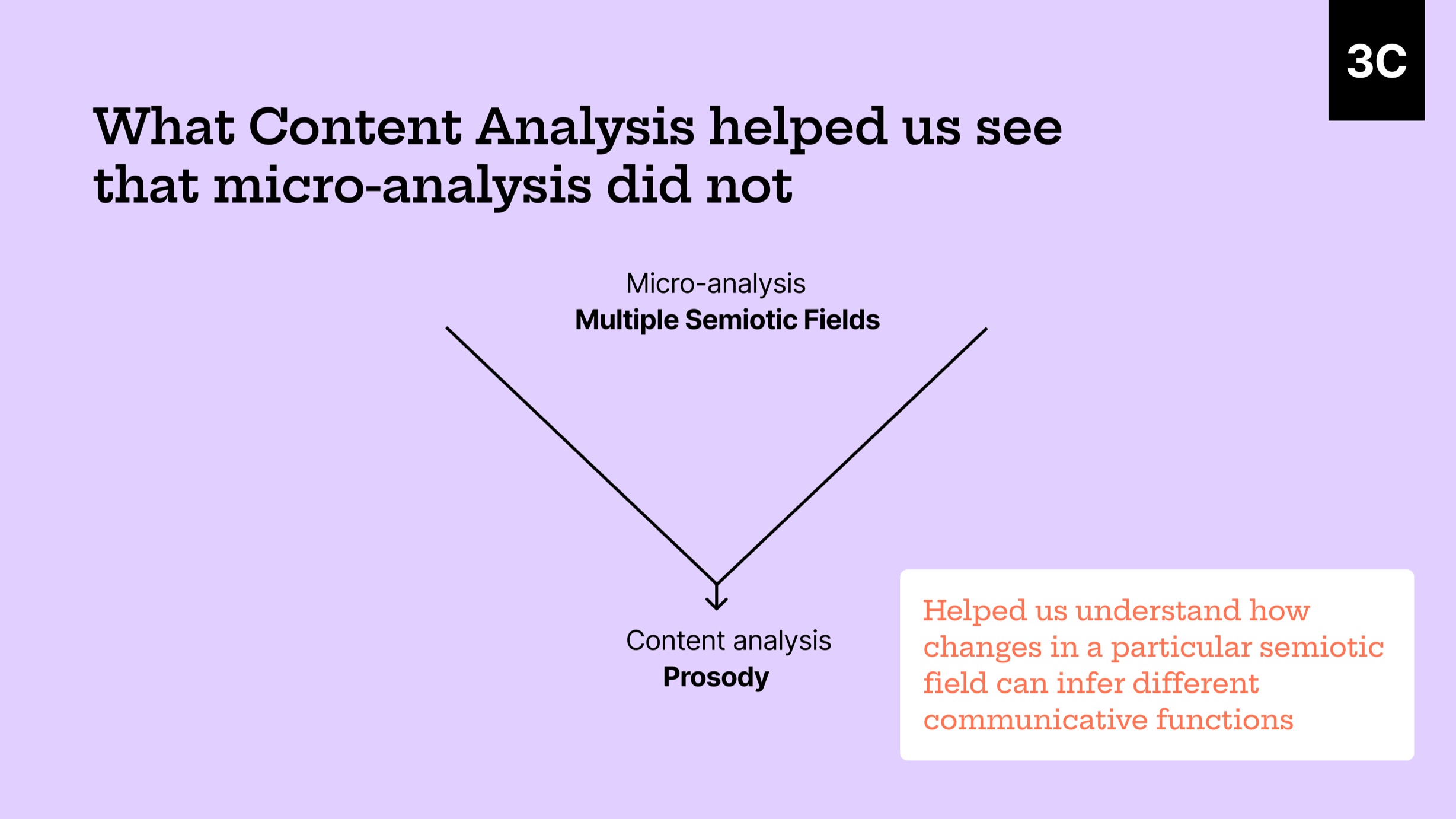
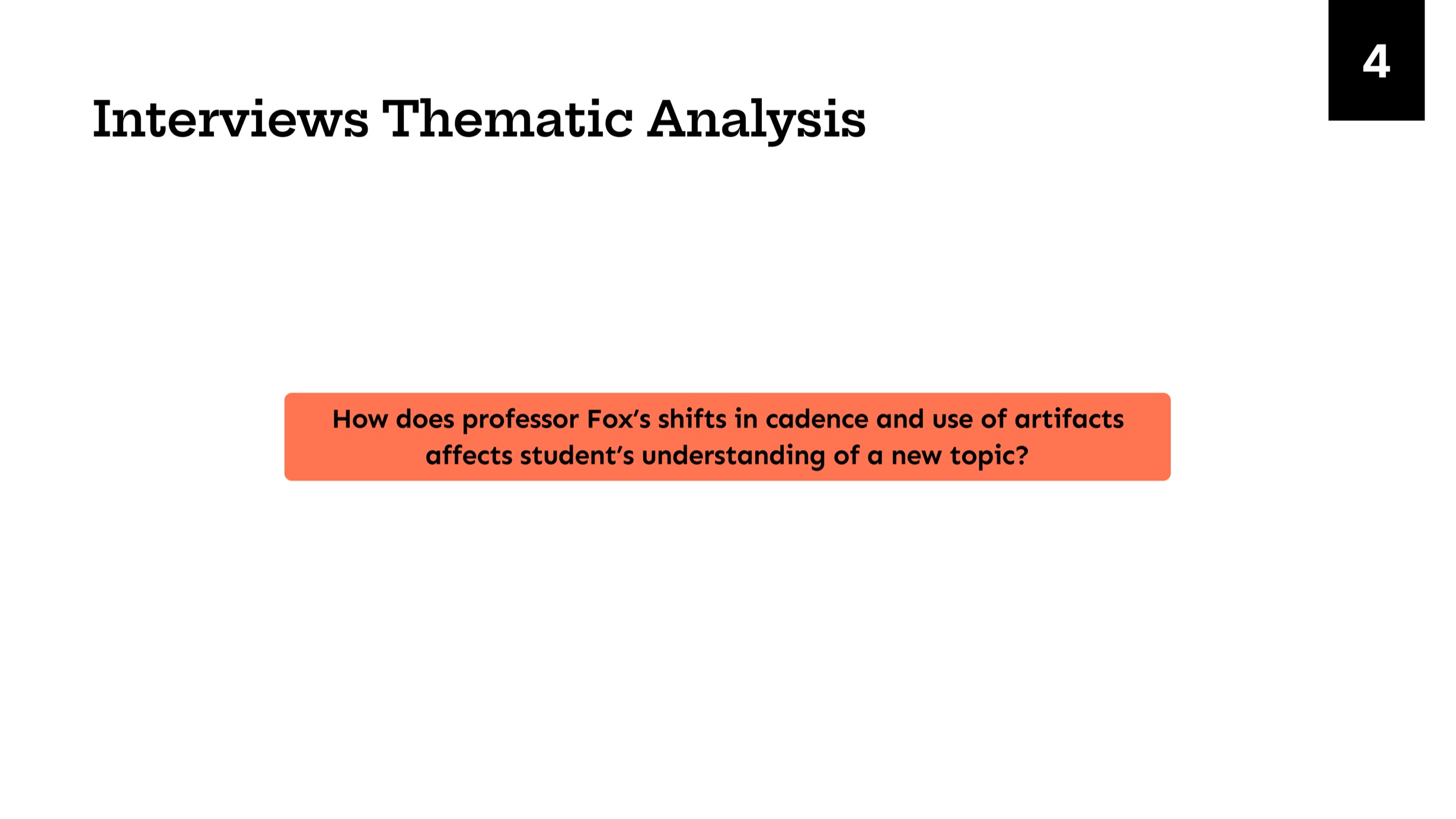
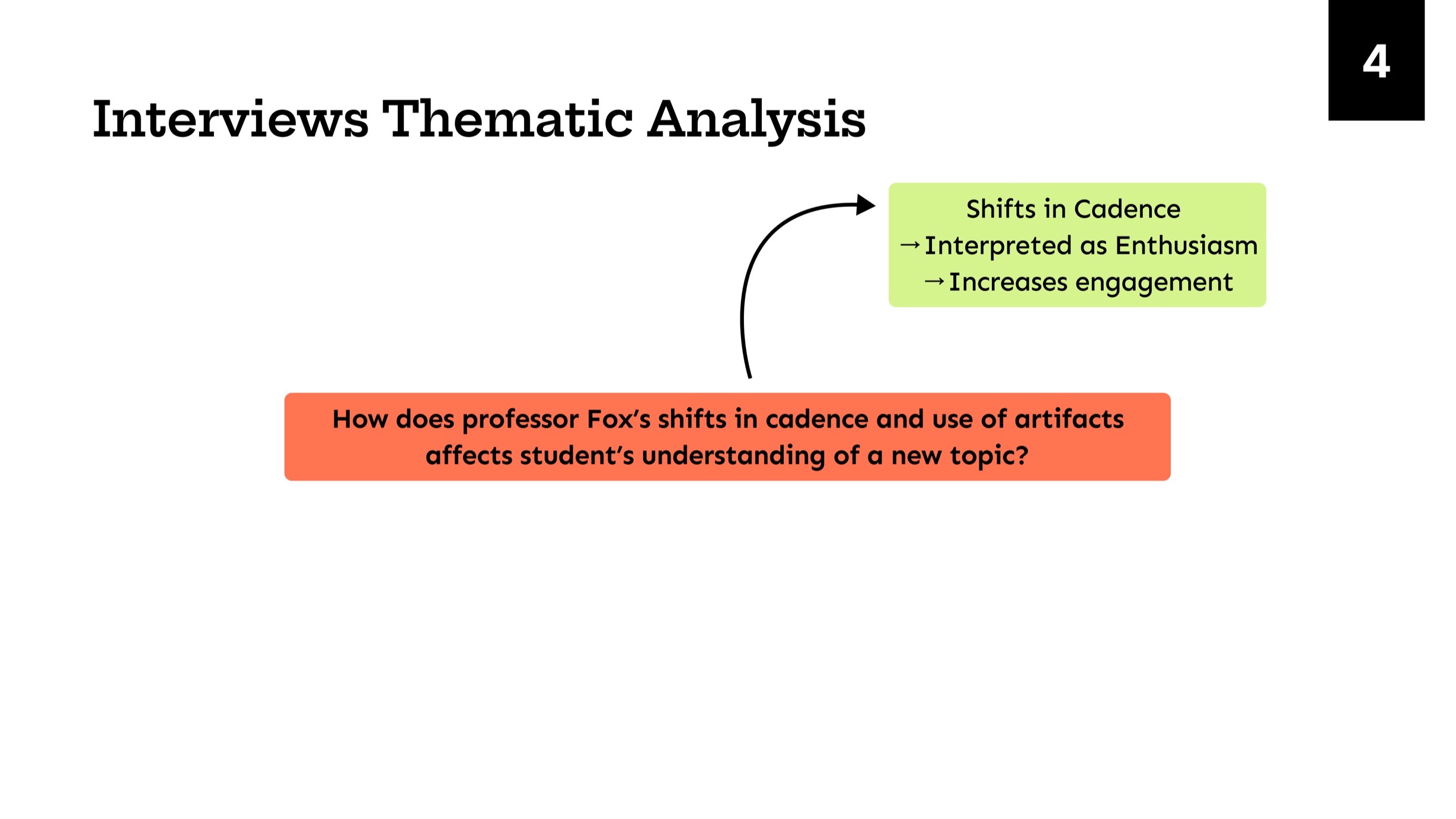
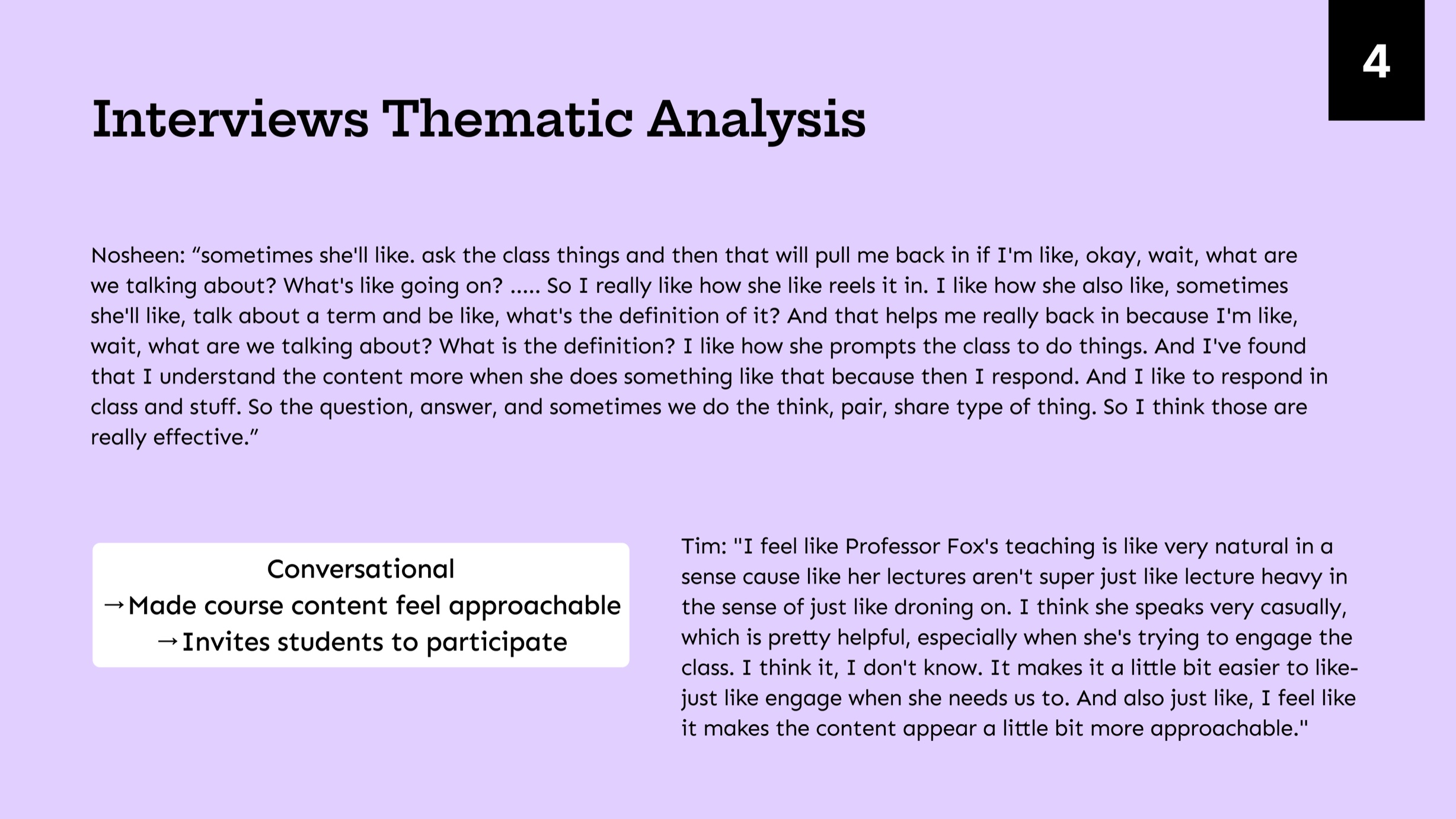


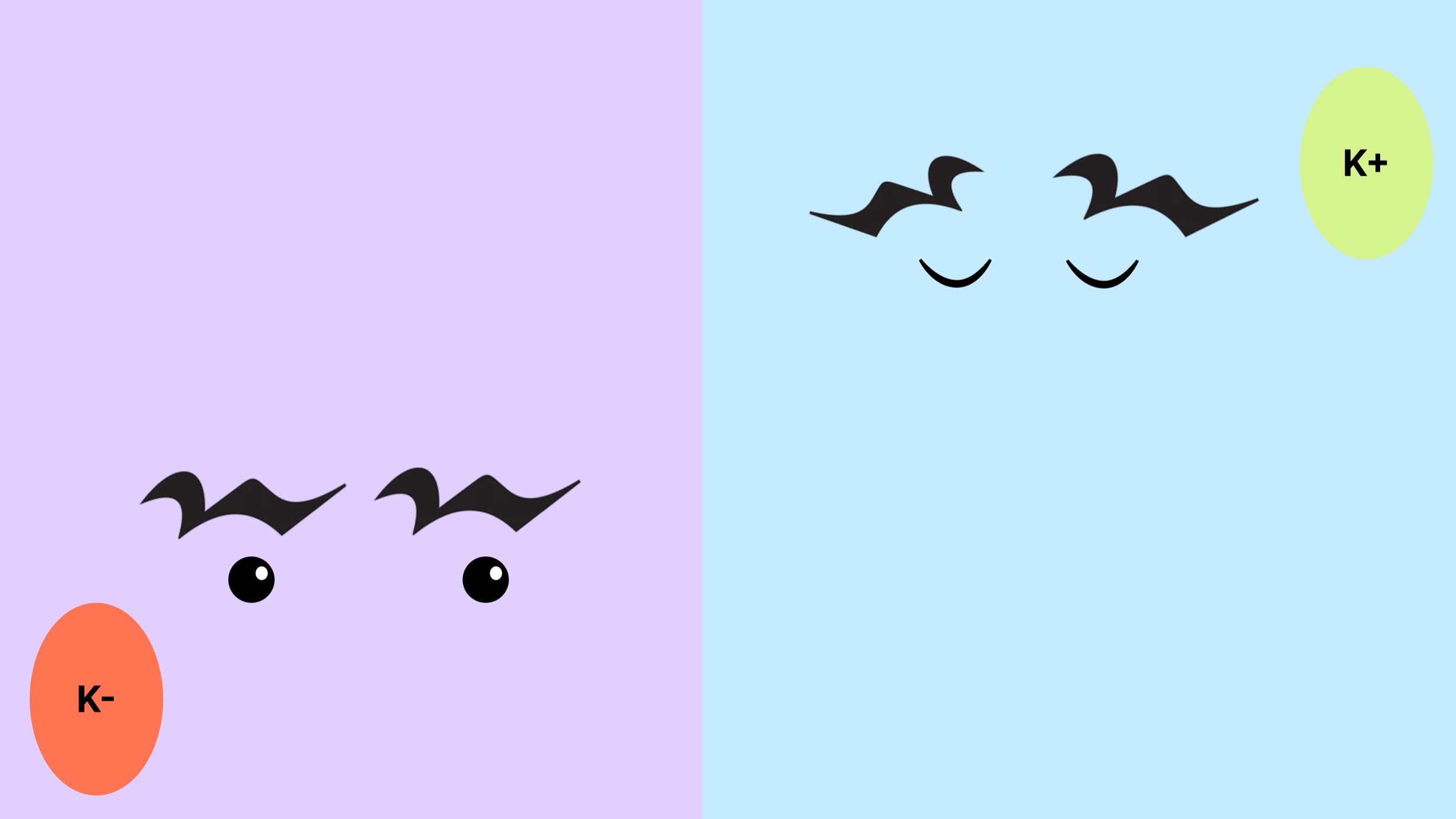
How Instructional Delivery during Lecture shapes Student Interpretation. Cognitive Ethnography, Savanna Li and Kalyani Joshi. 3A, The Activity: Professor Fox's lecture during Week 5, Epistemics in Action. 3A, The Activity: Professor Fox's lecture during Week 5, Epistemics in Action, tagged Quite Literally. 3A, The Activity. Why we selected this activity: we wanted to decode what made Professor Fox's lectures engaging. What made it analytically interesting: how she explains concepts and clarifies doubts, how students know they are invited to contribute, and which non-lexicosemantic semiotic fields signal these parts of a lecture.
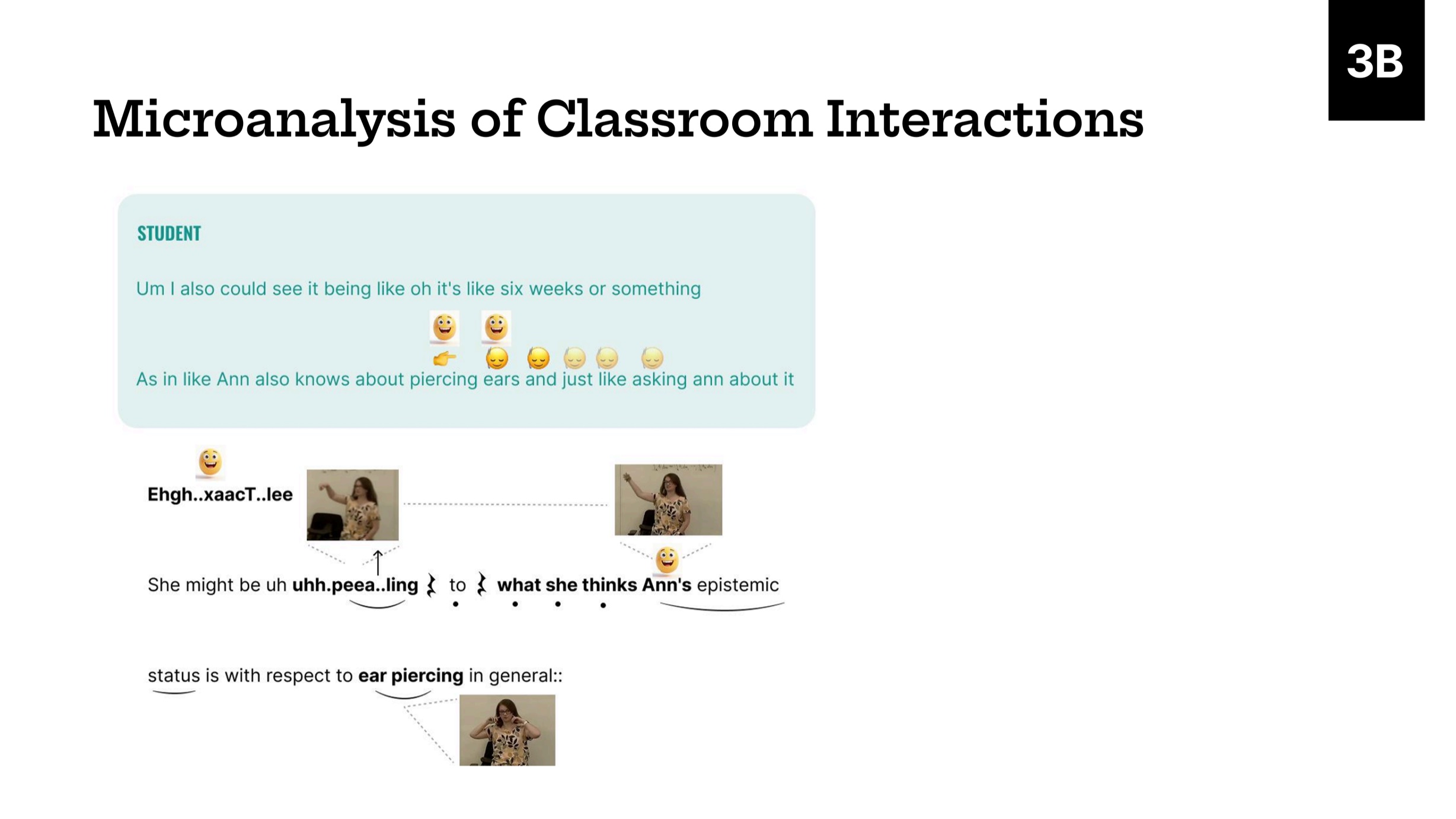
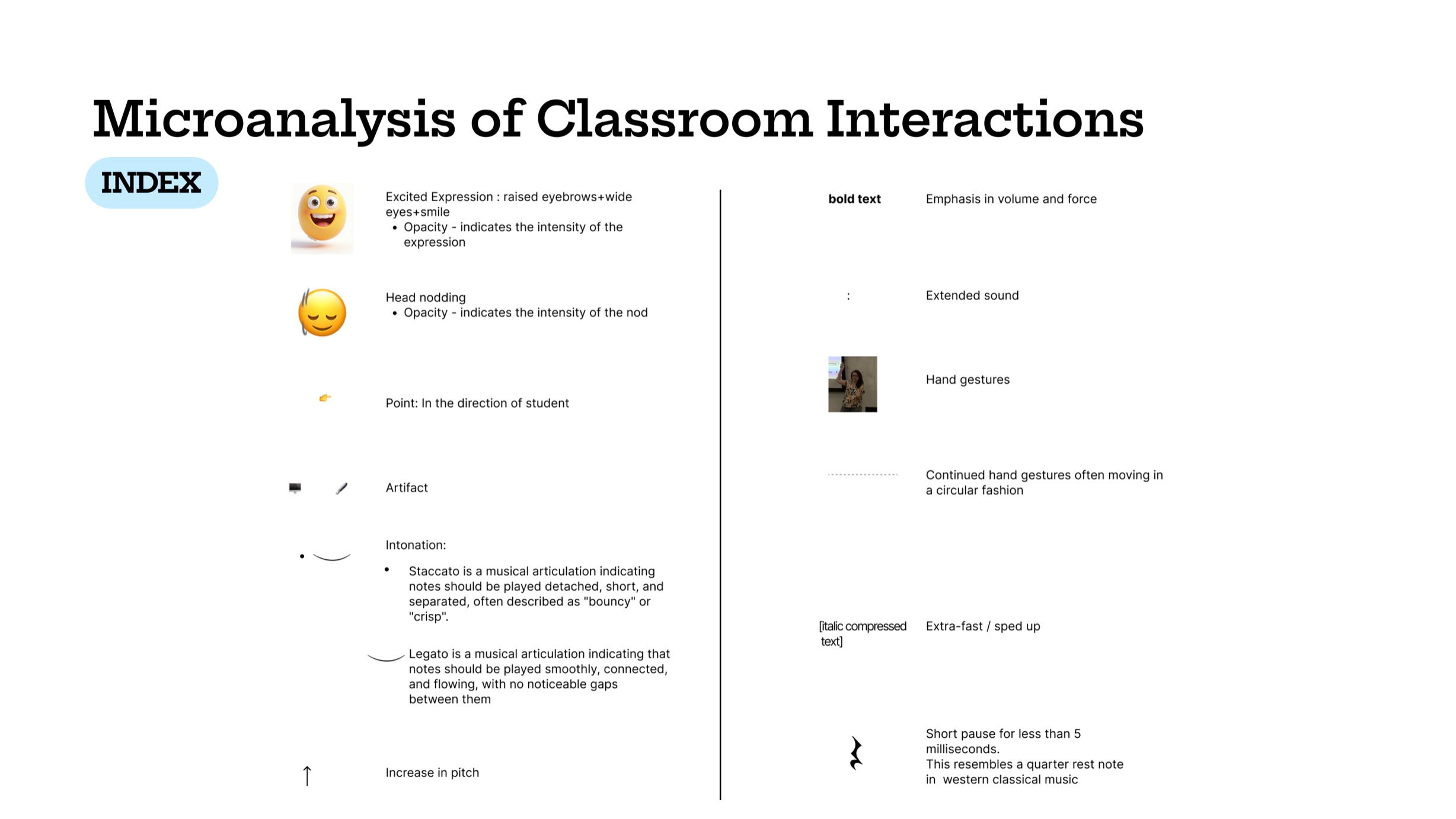
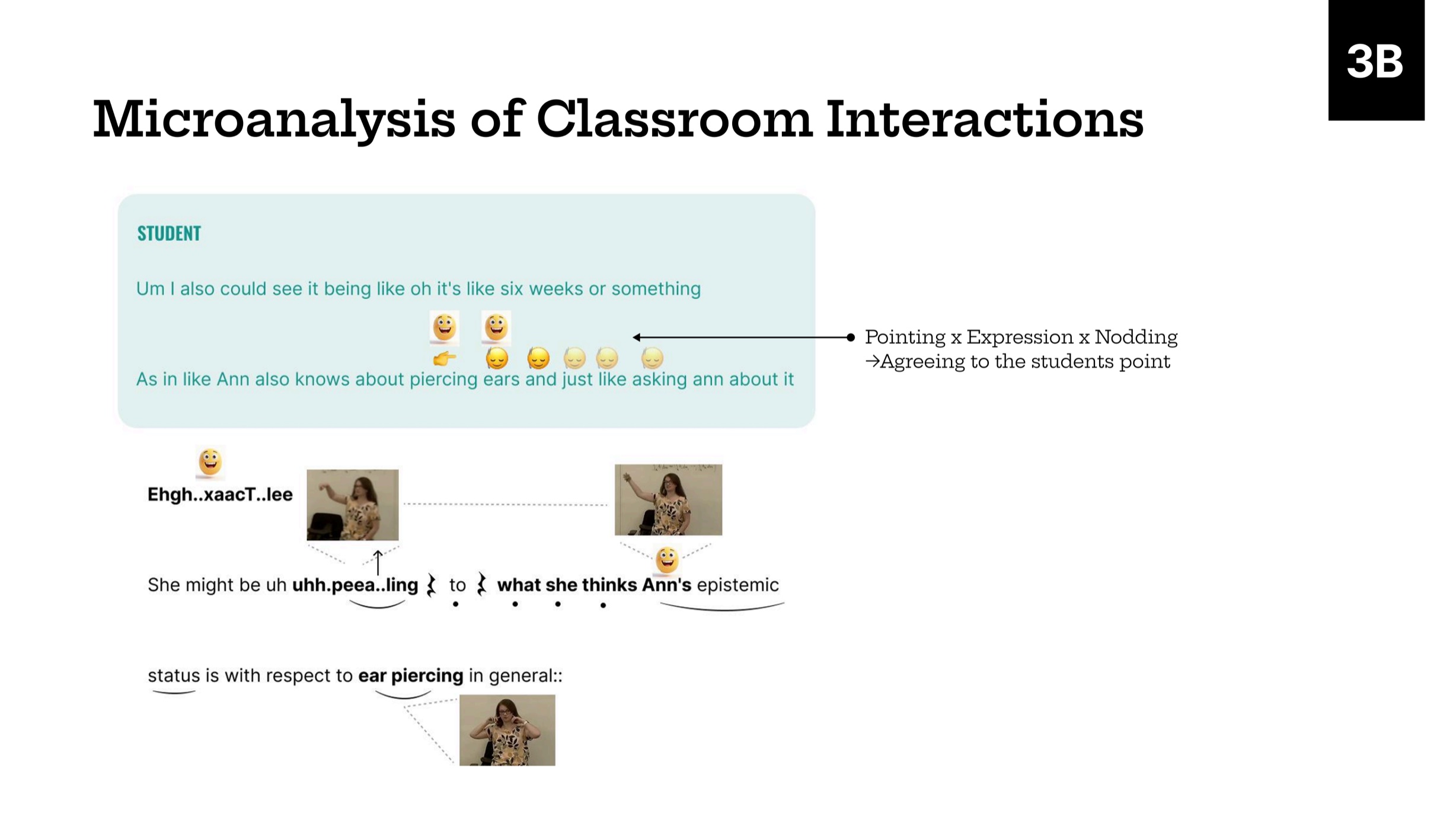
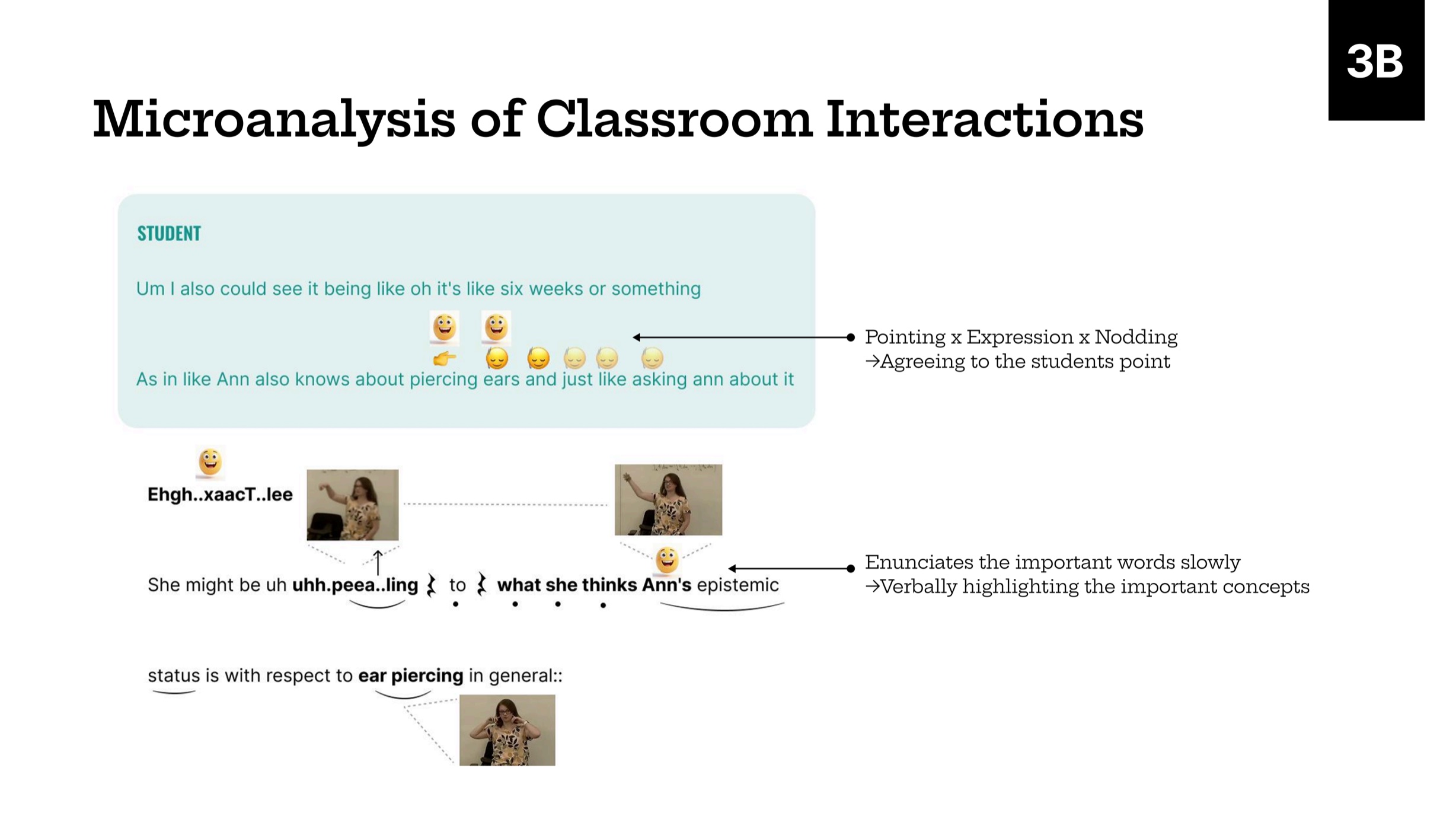
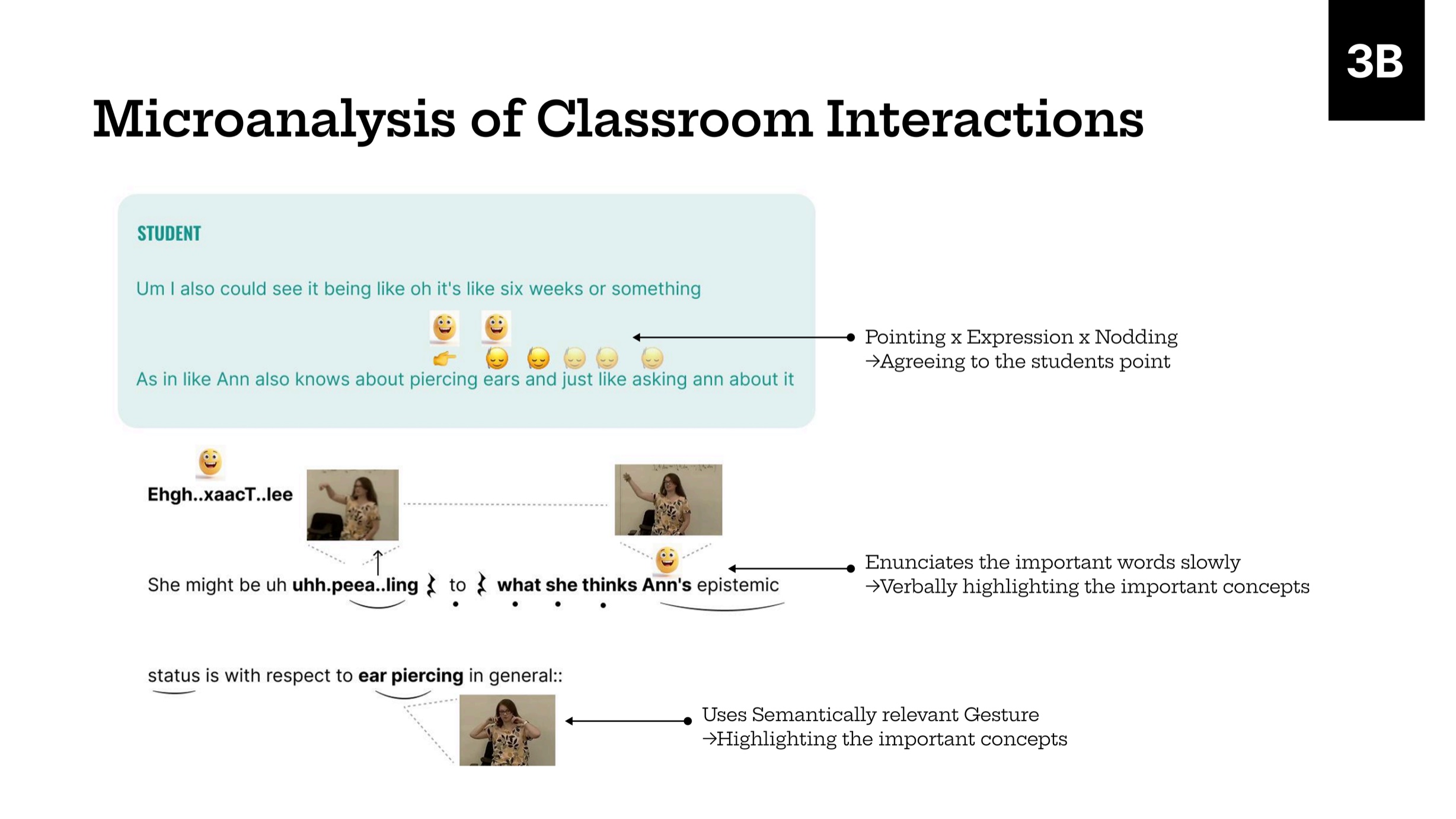
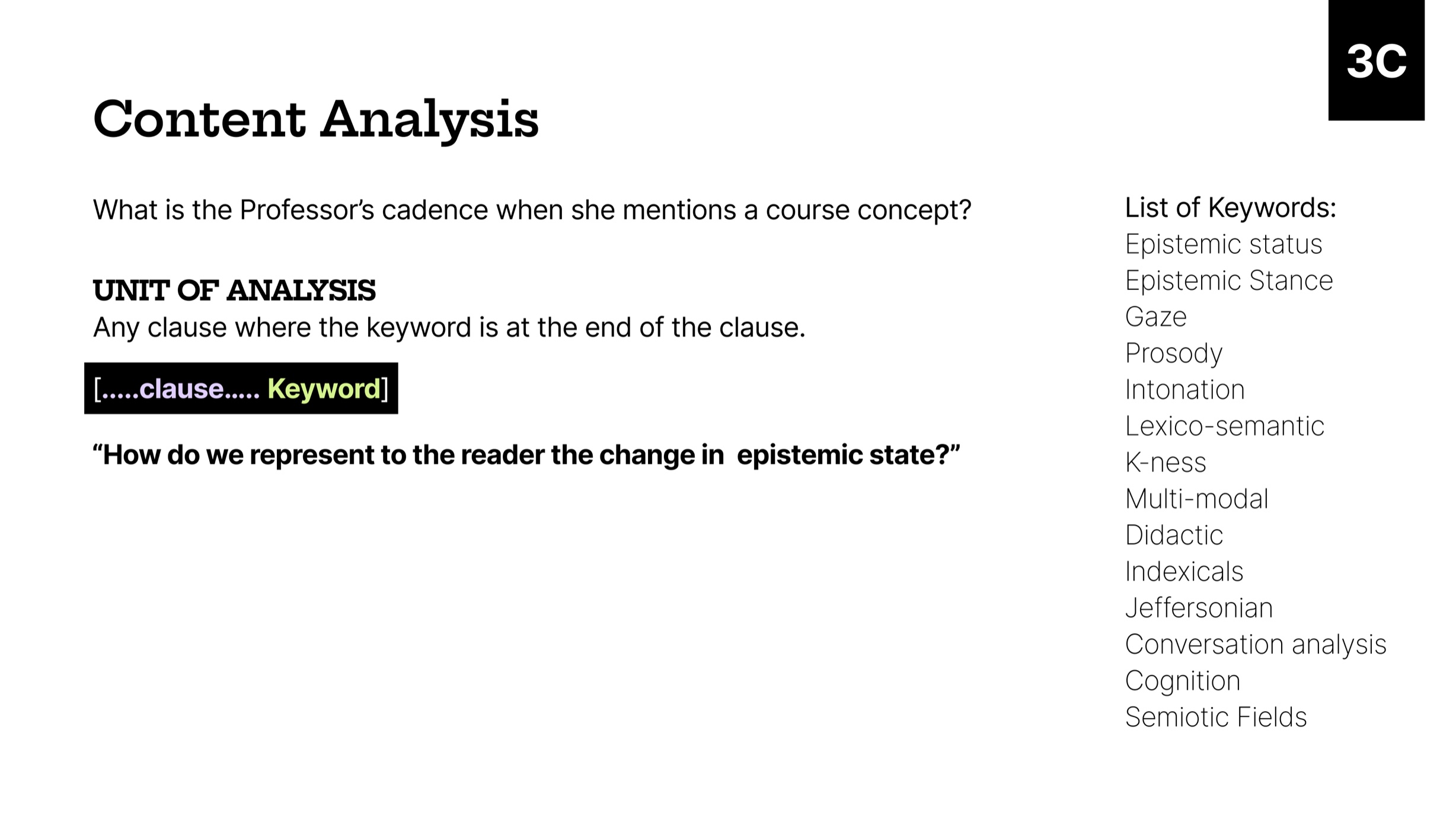
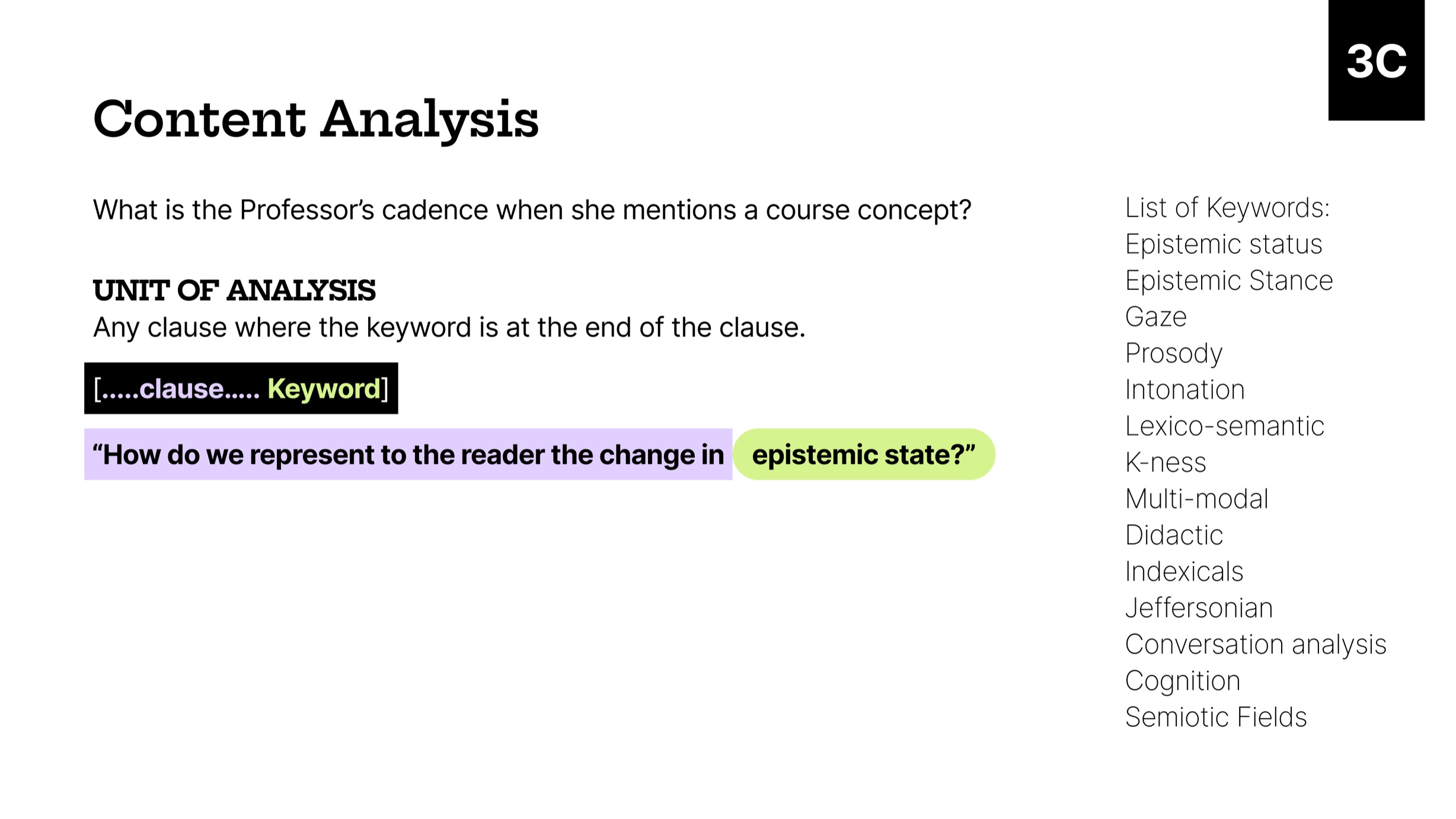
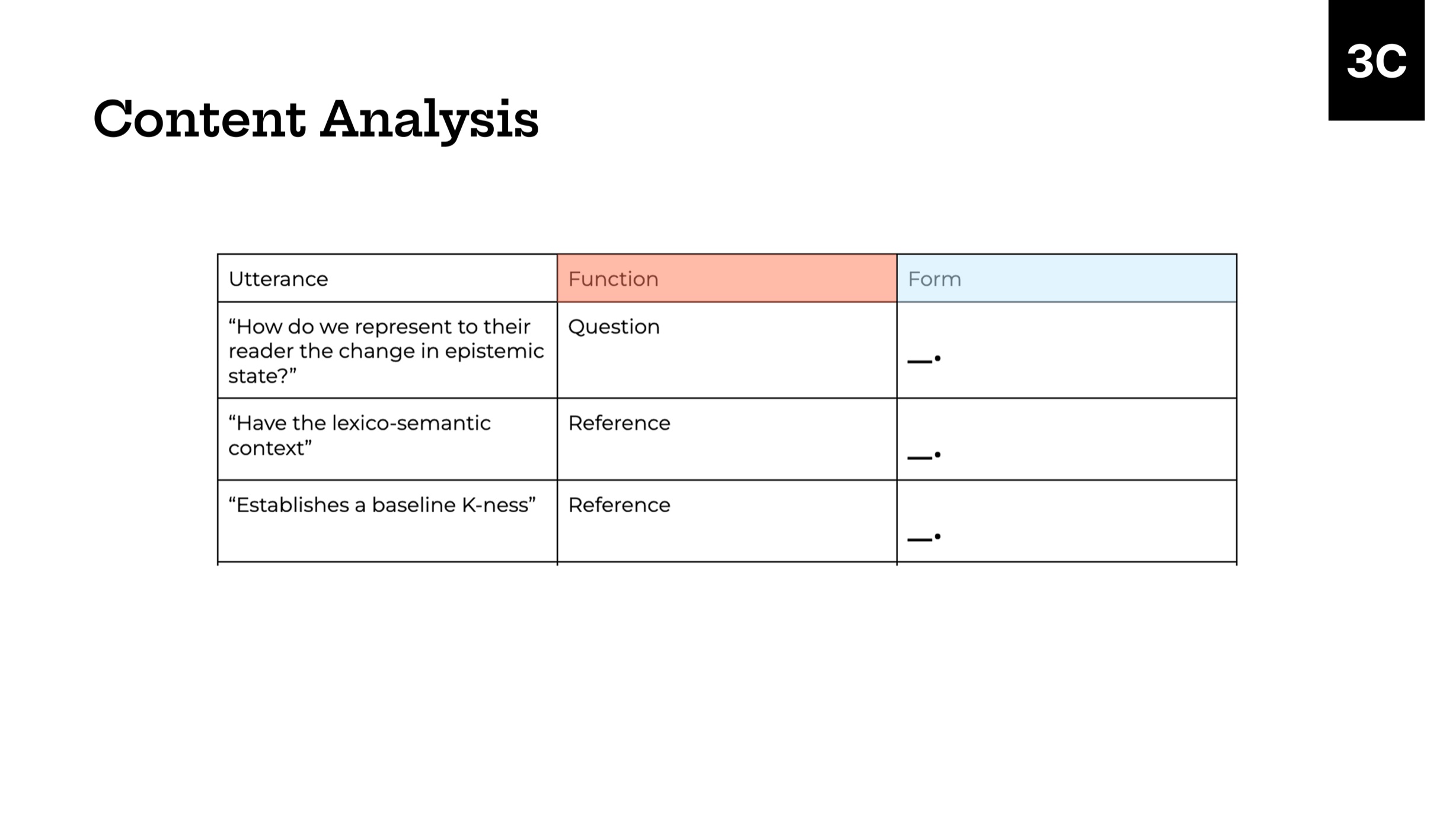
3B, Microanalysis of Classroom Interactions: a visual transcript of a student's comment and the professor's reply, using face icons for expressions and nodding, video stills of her gestures, and musical marks for rhythm and intonation. Microanalysis index: the transcript's symbols. Face icons for excited expressions and head nodding (opacity shows intensity), pointing, artifacts, intonation drawn as staccato dots and legato arcs, an arrow for rising pitch, bold for emphasis, a colon for extended sound, hand-gesture stills and lines, condensed italics for sped-up speech, and a quarter rest for short pauses. 3B, the visual transcript, annotated: pointing, expression and nodding show the professor agreeing with the student's point. 3B, the visual transcript, annotated: she also enunciates the important words slowly, verbally highlighting the key concepts. 3B, the visual transcript, annotated: she also uses a semantically relevant gesture to highlight the key concepts. 3C, Content Analysis. Question: what is the professor's cadence when she mentions a course concept? Unit of analysis: any clause where the keyword comes at the end of the clause, with the example quote "How do we represent to the reader the change in epistemic state?" and a list of course keywords from epistemic status to semiotic fields. 3C, Content Analysis: the example quote split into its clause and its keyword, epistemic state. 3C, Content Analysis: a coding table with each utterance, its function (question or reference) and its form. 3C, Content Analysis: the functions coded were question, instruction, and referencing context to explain an example. 3C, Content Analysis: the forms coded were dash then dot (a legato clause before a staccato keyword), dot then dash (staccato clause, legato keyword), and N/A where both sound the same. 3C, Content Analysis results table: of 34 utterances, 26 referenced context, 2 were instructions and 6 were questions. Reference utterances were spread out with slightly more prosodic speech (15 of 26); both instructions showed prosodic contrast; questions had the highest share of N/A. 3C, the results table with the takeaway: although most utterances were references, prosodic contrast appeared most consistently during instructional moments. What content analysis helped us see that micro-analysis did not: micro-analysis looked across multiple semiotic fields, and content analysis narrowed in on prosody. What content analysis helped us see that micro-analysis did not: it helped us understand how changes in one semiotic field can signal different communicative functions. 4, Interviews Thematic Analysis. Question: how do Professor Fox's shifts in cadence and use of artifacts affect students' understanding of a new topic? 4, Thematic Analysis, first theme: shifts in cadence are interpreted as enthusiasm and increase engagement. 4, Thematic Analysis, shifts in cadence: quotes from a student, Tim, saying he dozes off when an instructor lacks energy, and that variation in cadence and tone makes a lecture more interesting and easier to keep up with. 4, Thematic Analysis, second theme: examples. Familiar context helps learning, and artifacts help restore attention. 4, Thematic Analysis, examples: Tim says real-life examples like grocery shopping or hopscotch help him understand concepts beyond a purely theoretical framework. 4, Thematic Analysis, third theme: a conversational style made course content feel approachable and invites students to participate. 4, Thematic Analysis, conversational style: a student, Nosheen, says the professor's questions to the class pull her back in and help her understand, and Tim says her casual, natural style makes the content feel more approachable. Conclusion: lecture understanding is shaped by interactions between the instructor, students and visual artifacts, not just speech; contextual examples and shifts in cadence act as cues students use to understand course concepts; and these methods turn a broad question into concrete findings. Illustration: two pairs of closed, smiling eyes on a lavender background. Illustration: the two faces on lavender and light blue halves; the blue one says Jeffersonian Transcription. Illustration: the lavender face now looks up with open eyes, labelled K minus, while the blue face, labelled K plus, stays calm: knowing less versus knowing more. Thank you Prof. Fox and Jack for a deep dive into Cognitive Ethnography!
1 / 31

Cognitive Ethnography Methods

Exploring how instructional delivery shapes student interpretation

Context

This research project was conducted as part of COGS 102B: Cognitive Ethnography, a course taught by Professor Amy Rae Fox at UC San Diego.

Cognitive ethnography explores how people think, interpret, and construct meaning through interactions with their environment. To understand different qualitative research methods, we worked in pairs to explore one central question: How does instructional delivery during lectures shape student interpretation?

Methods

  1. Micro Analysis

    First, we conducted a micro analysis of classroom interactions, identifying the various semiotic fields through a multimodal transcript. My primary contribution was redesigning the traditionally dense, symbol-heavy Jeffersonian transcription into a more visual, accessible format. Drawing inspiration from musical notation, I used concepts like legato and staccato to represent shifts in speech rhythm and intonation.

  2. Content Analysis

    Next, we conducted a content analysis, examining the frequency and co-occurrence of specific clauses and keywords to identify patterns in instructional delivery.

  3. Thematic Analysis

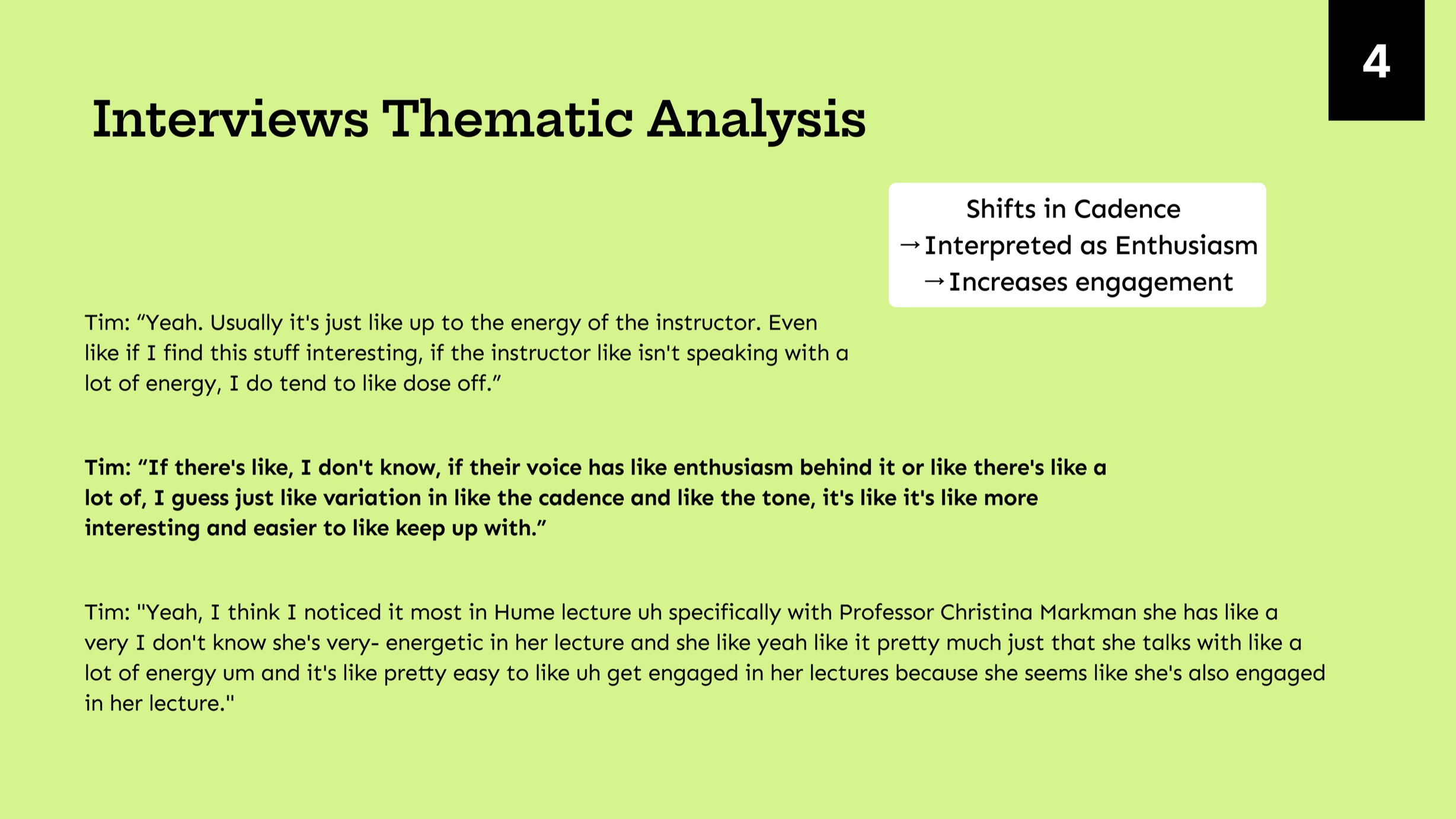
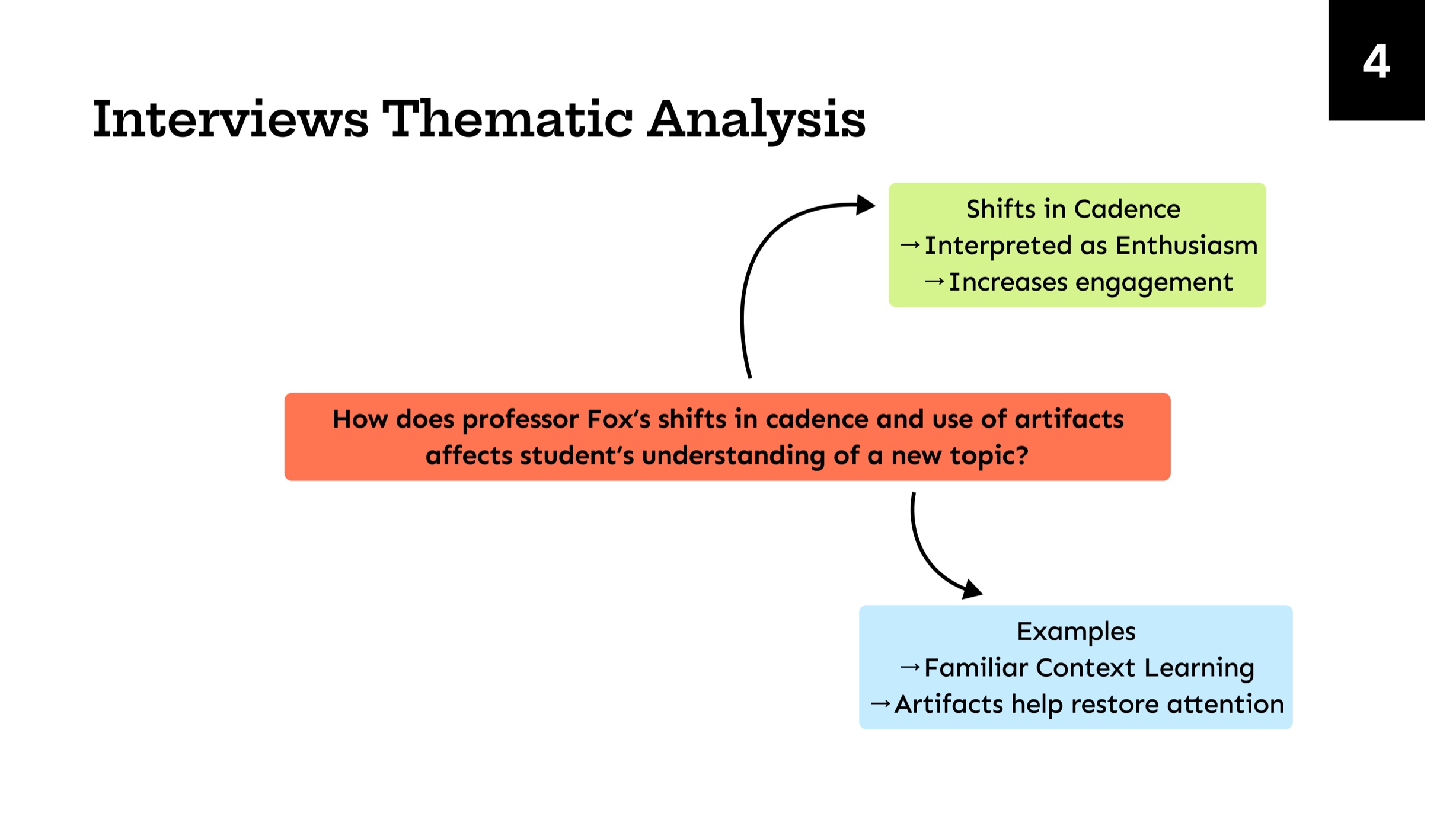
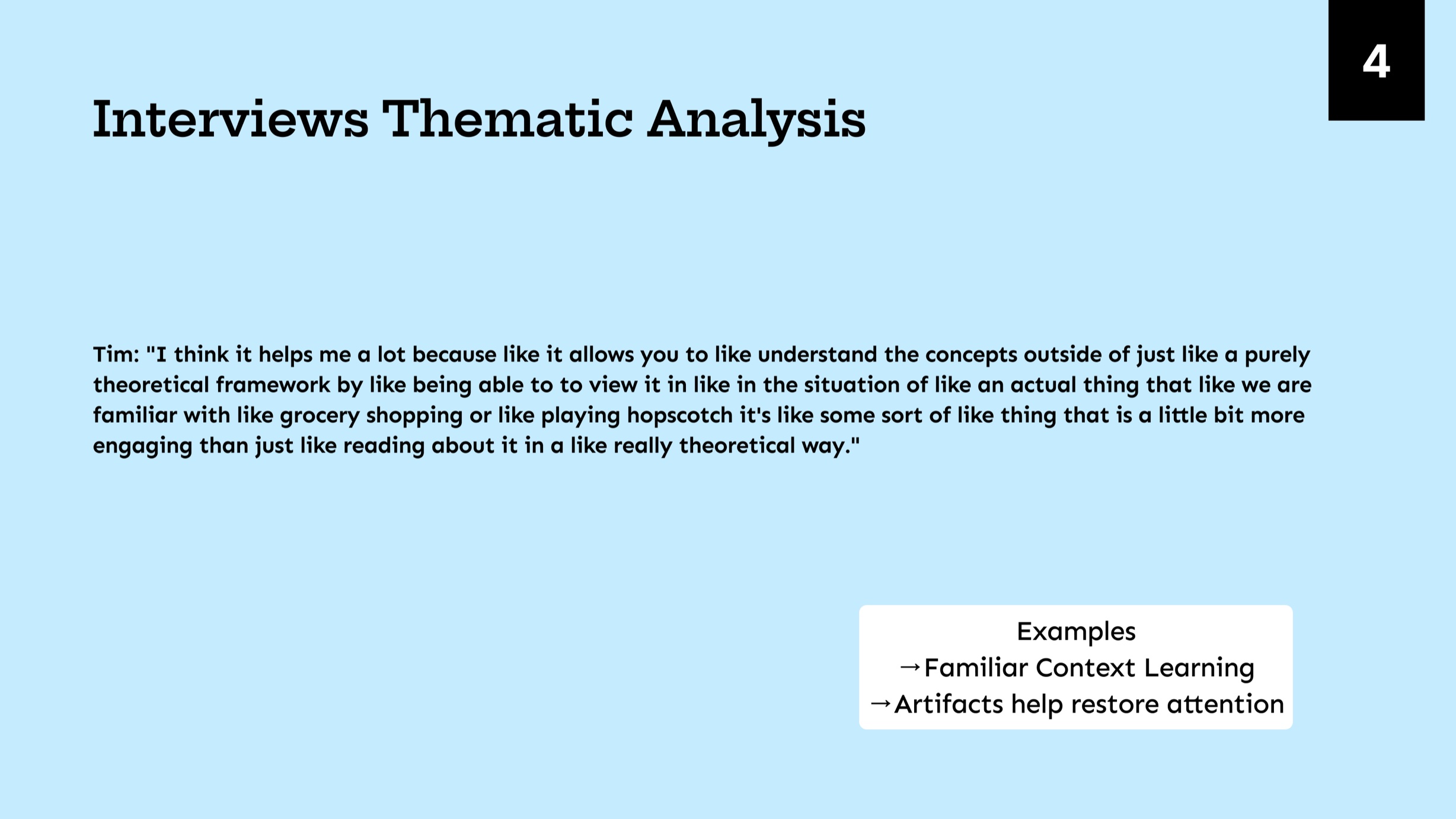
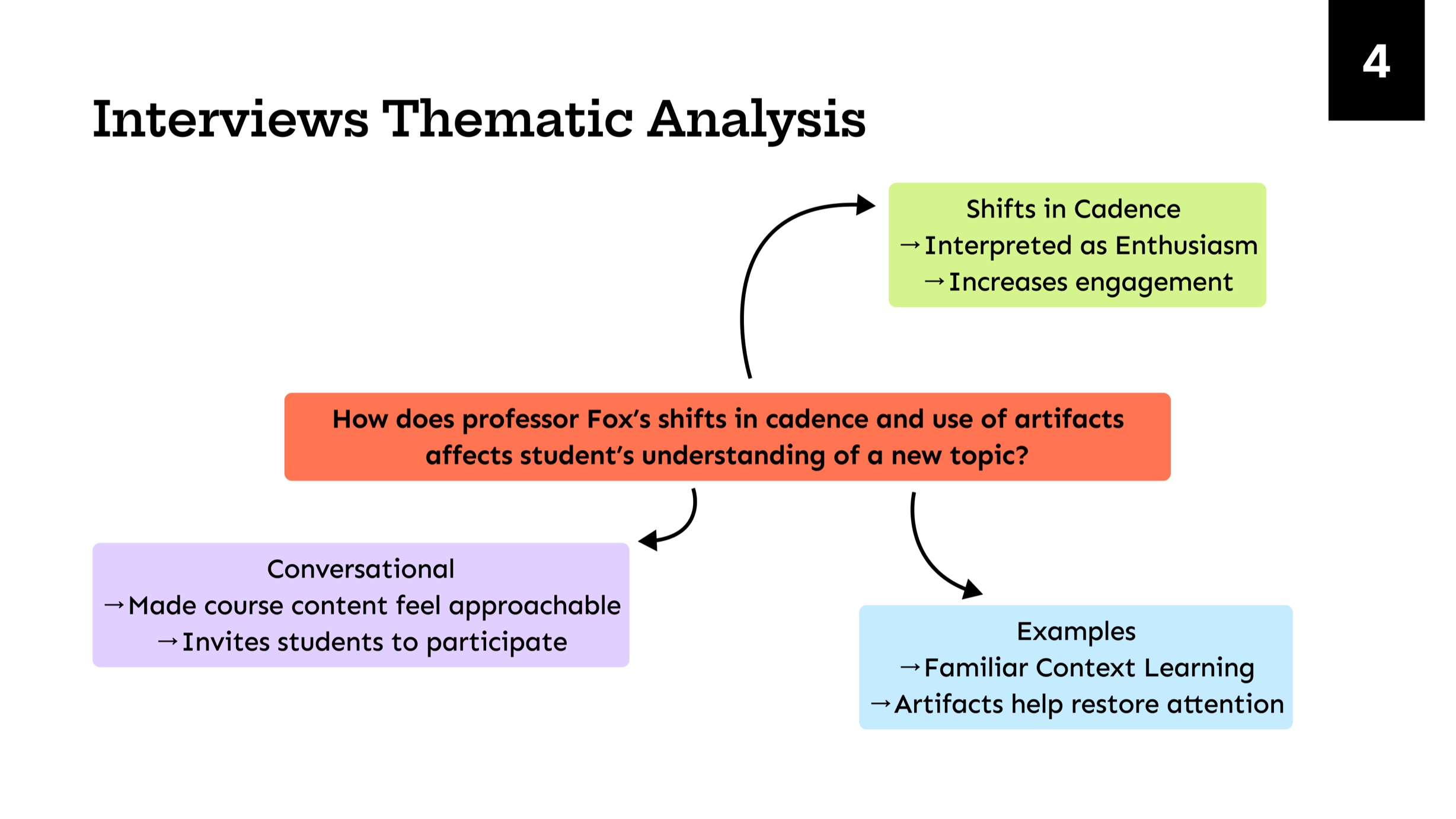
    Finally, we used Condens.io to conduct a thematic analysis of student interviews, exploring how students interpreted the lectures.

Tools

Condens.io

Role

UX Researcher
Info Viz
Interview Analysis
Team of 2

How Instructional Delivery during Lecture shapes Student Interpretation. Cognitive Ethnography, Savanna Li and Kalyani Joshi. 3A, The Activity: Professor Fox's lecture during Week 5, Epistemics in Action. 3A, The Activity: Professor Fox's lecture during Week 5, Epistemics in Action, tagged Quite Literally. 3A, The Activity. Why we selected this activity: we wanted to decode what made Professor Fox's lectures engaging. What made it analytically interesting: how she explains concepts and clarifies doubts, how students know they are invited to contribute, and which non-lexicosemantic semiotic fields signal these parts of a lecture.
3B, Microanalysis of Classroom Interactions: a visual transcript of a student's comment and the professor's reply, using face icons for expressions and nodding, video stills of her gestures, and musical marks for rhythm and intonation. Microanalysis index: the transcript's symbols. Face icons for excited expressions and head nodding (opacity shows intensity), pointing, artifacts, intonation drawn as staccato dots and legato arcs, an arrow for rising pitch, bold for emphasis, a colon for extended sound, hand-gesture stills and lines, condensed italics for sped-up speech, and a quarter rest for short pauses. 3B, the visual transcript, annotated: pointing, expression and nodding show the professor agreeing with the student's point. 3B, the visual transcript, annotated: she also enunciates the important words slowly, verbally highlighting the key concepts. 3B, the visual transcript, annotated: she also uses a semantically relevant gesture to highlight the key concepts. 3C, Content Analysis. Question: what is the professor's cadence when she mentions a course concept? Unit of analysis: any clause where the keyword comes at the end of the clause, with the example quote "How do we represent to the reader the change in epistemic state?" and a list of course keywords from epistemic status to semiotic fields. 3C, Content Analysis: the example quote split into its clause and its keyword, epistemic state. 3C, Content Analysis: a coding table with each utterance, its function (question or reference) and its form. 3C, Content Analysis: the functions coded were question, instruction, and referencing context to explain an example. 3C, Content Analysis: the forms coded were dash then dot (a legato clause before a staccato keyword), dot then dash (staccato clause, legato keyword), and N/A where both sound the same. 3C, Content Analysis results table: of 34 utterances, 26 referenced context, 2 were instructions and 6 were questions. Reference utterances were spread out with slightly more prosodic speech (15 of 26); both instructions showed prosodic contrast; questions had the highest share of N/A. 3C, the results table with the takeaway: although most utterances were references, prosodic contrast appeared most consistently during instructional moments. What content analysis helped us see that micro-analysis did not: micro-analysis looked across multiple semiotic fields, and content analysis narrowed in on prosody. What content analysis helped us see that micro-analysis did not: it helped us understand how changes in one semiotic field can signal different communicative functions. 4, Interviews Thematic Analysis. Question: how do Professor Fox's shifts in cadence and use of artifacts affect students' understanding of a new topic? 4, Thematic Analysis, first theme: shifts in cadence are interpreted as enthusiasm and increase engagement. 4, Thematic Analysis, shifts in cadence: quotes from a student, Tim, saying he dozes off when an instructor lacks energy, and that variation in cadence and tone makes a lecture more interesting and easier to keep up with. 4, Thematic Analysis, second theme: examples. Familiar context helps learning, and artifacts help restore attention. 4, Thematic Analysis, examples: Tim says real-life examples like grocery shopping or hopscotch help him understand concepts beyond a purely theoretical framework. 4, Thematic Analysis, third theme: a conversational style made course content feel approachable and invites students to participate. 4, Thematic Analysis, conversational style: a student, Nosheen, says the professor's questions to the class pull her back in and help her understand, and Tim says her casual, natural style makes the content feel more approachable. Conclusion: lecture understanding is shaped by interactions between the instructor, students and visual artifacts, not just speech; contextual examples and shifts in cadence act as cues students use to understand course concepts; and these methods turn a broad question into concrete findings. Illustration: two pairs of closed, smiling eyes on a lavender background. Illustration: the two faces on lavender and light blue halves; the blue one says Jeffersonian Transcription. Illustration: the lavender face now looks up with open eyes, labelled K minus, while the blue face, labelled K plus, stays calm: knowing less versus knowing more. Thank you Prof. Fox and Jack for a deep dive into Cognitive Ethnography!
1 / 31

Cognitive Ethnography Methods

Exploring how instructional delivery shapes student interpretation

Tools

Condens.io

Role

UX Researcher · Info Viz · Interview Analysis · Team of 2

Context

This research project was conducted as part of COGS 102B: Cognitive Ethnography, a course taught by Professor Amy Rae Fox at UC San Diego.

Cognitive ethnography explores how people think, interpret, and construct meaning through interactions with their environment. To understand different qualitative research methods, we worked in pairs to explore one central question: How does instructional delivery during lectures shape student interpretation?

Methods

  1. Micro Analysis

    First, we conducted a micro analysis of classroom interactions, identifying the various semiotic fields through a multimodal transcript. My primary contribution was redesigning the traditionally dense, symbol-heavy Jeffersonian transcription into a more visual, accessible format. Drawing inspiration from musical notation, I used concepts like legato and staccato to represent shifts in speech rhythm and intonation.

  2. Content Analysis

    Next, we conducted a content analysis, examining the frequency and co-occurrence of specific clauses and keywords to identify patterns in instructional delivery.

  3. Thematic Analysis

    Finally, we used Condens.io to conduct a thematic analysis of student interviews, exploring how students interpreted the lectures.

How Instructional Delivery during Lecture shapes Student Interpretation. Cognitive Ethnography, Savanna Li and Kalyani Joshi. 3A, The Activity: Professor Fox's lecture during Week 5, Epistemics in Action. 3A, The Activity: Professor Fox's lecture during Week 5, Epistemics in Action, tagged Quite Literally. 3A, The Activity. Why we selected this activity: we wanted to decode what made Professor Fox's lectures engaging. What made it analytically interesting: how she explains concepts and clarifies doubts, how students know they are invited to contribute, and which non-lexicosemantic semiotic fields signal these parts of a lecture.
3B, Microanalysis of Classroom Interactions: a visual transcript of a student's comment and the professor's reply, using face icons for expressions and nodding, video stills of her gestures, and musical marks for rhythm and intonation. Microanalysis index: the transcript's symbols. Face icons for excited expressions and head nodding (opacity shows intensity), pointing, artifacts, intonation drawn as staccato dots and legato arcs, an arrow for rising pitch, bold for emphasis, a colon for extended sound, hand-gesture stills and lines, condensed italics for sped-up speech, and a quarter rest for short pauses. 3B, the visual transcript, annotated: pointing, expression and nodding show the professor agreeing with the student's point. 3B, the visual transcript, annotated: she also enunciates the important words slowly, verbally highlighting the key concepts. 3B, the visual transcript, annotated: she also uses a semantically relevant gesture to highlight the key concepts. 3C, Content Analysis. Question: what is the professor's cadence when she mentions a course concept? Unit of analysis: any clause where the keyword comes at the end of the clause, with the example quote "How do we represent to the reader the change in epistemic state?" and a list of course keywords from epistemic status to semiotic fields. 3C, Content Analysis: the example quote split into its clause and its keyword, epistemic state. 3C, Content Analysis: a coding table with each utterance, its function (question or reference) and its form. 3C, Content Analysis: the functions coded were question, instruction, and referencing context to explain an example. 3C, Content Analysis: the forms coded were dash then dot (a legato clause before a staccato keyword), dot then dash (staccato clause, legato keyword), and N/A where both sound the same. 3C, Content Analysis results table: of 34 utterances, 26 referenced context, 2 were instructions and 6 were questions. Reference utterances were spread out with slightly more prosodic speech (15 of 26); both instructions showed prosodic contrast; questions had the highest share of N/A. 3C, the results table with the takeaway: although most utterances were references, prosodic contrast appeared most consistently during instructional moments. What content analysis helped us see that micro-analysis did not: micro-analysis looked across multiple semiotic fields, and content analysis narrowed in on prosody. What content analysis helped us see that micro-analysis did not: it helped us understand how changes in one semiotic field can signal different communicative functions. 4, Interviews Thematic Analysis. Question: how do Professor Fox's shifts in cadence and use of artifacts affect students' understanding of a new topic? 4, Thematic Analysis, first theme: shifts in cadence are interpreted as enthusiasm and increase engagement. 4, Thematic Analysis, shifts in cadence: quotes from a student, Tim, saying he dozes off when an instructor lacks energy, and that variation in cadence and tone makes a lecture more interesting and easier to keep up with. 4, Thematic Analysis, second theme: examples. Familiar context helps learning, and artifacts help restore attention. 4, Thematic Analysis, examples: Tim says real-life examples like grocery shopping or hopscotch help him understand concepts beyond a purely theoretical framework. 4, Thematic Analysis, third theme: a conversational style made course content feel approachable and invites students to participate. 4, Thematic Analysis, conversational style: a student, Nosheen, says the professor's questions to the class pull her back in and help her understand, and Tim says her casual, natural style makes the content feel more approachable. Conclusion: lecture understanding is shaped by interactions between the instructor, students and visual artifacts, not just speech; contextual examples and shifts in cadence act as cues students use to understand course concepts; and these methods turn a broad question into concrete findings. Illustration: two pairs of closed, smiling eyes on a lavender background. Illustration: the two faces on lavender and light blue halves; the blue one says Jeffersonian Transcription. Illustration: the lavender face now looks up with open eyes, labelled K minus, while the blue face, labelled K plus, stays calm: knowing less versus knowing more. Thank you Prof. Fox and Jack for a deep dive into Cognitive Ethnography!
1 / 31

Cognitive Ethnography Methods

Exploring how instructional delivery shapes student interpretation

Tools

Condens.io

Role

UX Researcher
Info Viz
Interview Analysis
Team of 2

Context

This research project was conducted as part of COGS 102B: Cognitive Ethnography, a course taught by Professor Amy Rae Fox at UC San Diego.

Cognitive ethnography explores how people think, interpret, and construct meaning through interactions with their environment. To understand different qualitative research methods, we worked in pairs to explore one central question: How does instructional delivery during lectures shape student interpretation?

Methods

  1. Micro Analysis

    First, we conducted a micro analysis of classroom interactions, identifying the various semiotic fields through a multimodal transcript. My primary contribution was redesigning the traditionally dense, symbol-heavy Jeffersonian transcription into a more visual, accessible format. Drawing inspiration from musical notation, I used concepts like legato and staccato to represent shifts in speech rhythm and intonation.

  2. Content Analysis

    Next, we conducted a content analysis, examining the frequency and co-occurrence of specific clauses and keywords to identify patterns in instructional delivery.

  3. Thematic Analysis

    Finally, we used Condens.io to conduct a thematic analysis of student interviews, exploring how students interpreted the lectures.